
Robotic Joint Replacement in Sydney
```Robotic assistance gives your surgeon a detailed plan of your hip or knee and helps reproduce that plan during joint replacement — while your specialist remains in control of every stage of the operation and your rehabilitation is managed alongside your surgery at MTP Health.
What is robotic joint replacement?
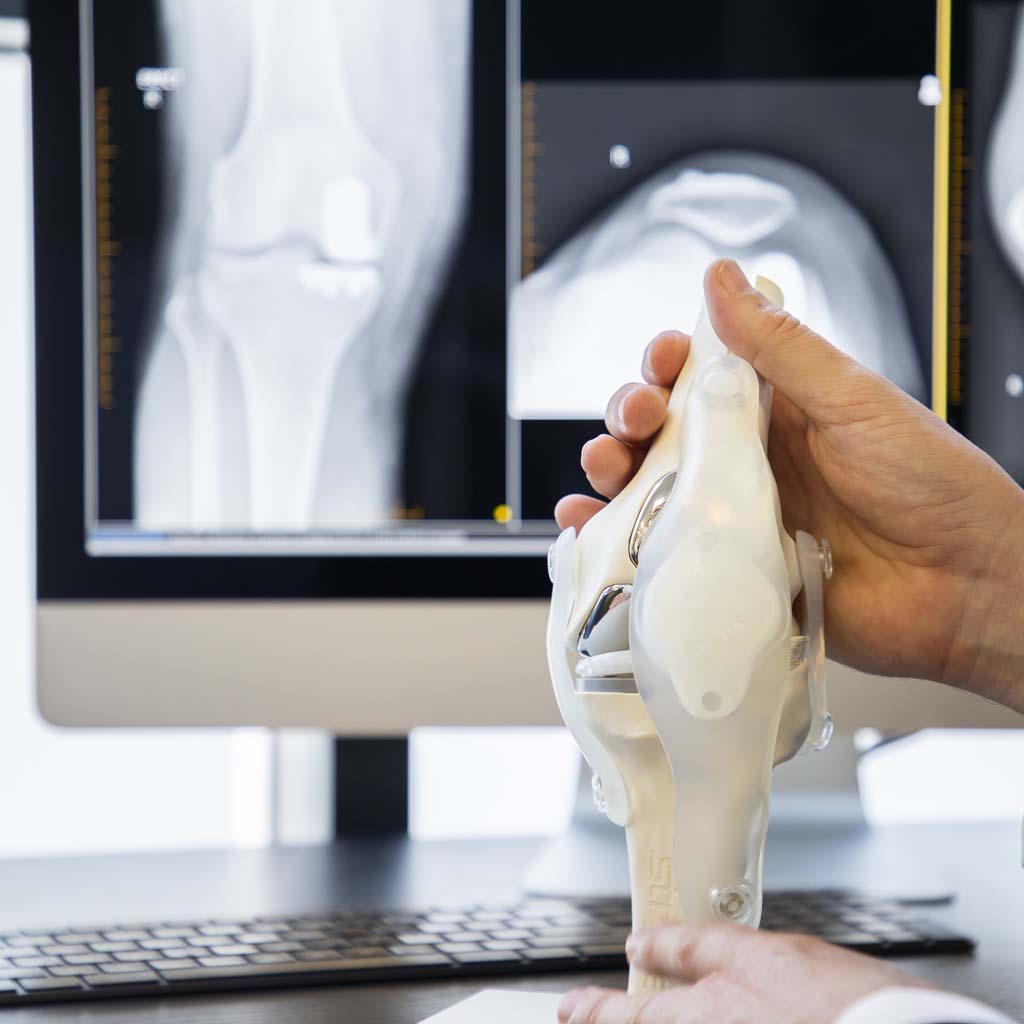
Robotic joint replacement is a form of computer-assisted surgery used during selected hip and knee replacements. It combines digital planning with a surgeon-controlled robotic system to help prepare the bone and position the joint replacement components according to a defined surgical plan.
The term “robotic surgery” can make it sound as though a robot performs the operation independently. That is not what happens. Your specialist orthopaedic surgeon performs the procedure, selects the implant, decides its position, handles the tissues and remains responsible for every stage of the operation.
The robotic system is a tool used by the surgeon. Depending on the system and operation, it may provide a three-dimensional model of the joint, real-time information about alignment and movement, or a robotic arm that guides the cutting or preparation instrument within defined boundaries.
Robotic assistance can be used during:
Different robotic systems work in different ways. Some require a pre-operative CT scan, while others create or refine the plan using information collected during surgery. Some use a robotic arm, while others provide navigation, visual guidance or controlled cutting tools. The implant choices available can also depend on the robotic platform being used.

Do you need robotic joint replacement?
The decision to have joint replacement should be based on your symptoms, examination, imaging, health and response to non-surgical treatment. It should not be based on the availability of a robot alone.
You may be considered for hip or knee replacement if arthritis or another joint condition is causing persistent pain, stiffness, reduced mobility or loss of quality of life despite appropriate non-operative care. Depending on the joint and diagnosis, this care may include education, exercise, strength training, weight management, medication, activity modification and injections.
The first question is whether you need a joint replacement — not whether it should be robotic. Our Osteoarthritis Clinic, physiotherapy team and exercise physiologists can help you explore non-surgical treatment first. If surgery becomes appropriate, your surgeon can then discuss whether robotic assistance offers a useful option for your procedure.
Robotic assistance may be available for many routine primary joint replacements, but it is not necessarily appropriate or available for every patient. Factors that can affect suitability include:
- The joint being replaced
- Whether you need a total or partial replacement
- The type and severity of arthritis
- Your anatomy and any joint deformity
- Previous surgery, fractures or metalwork
- The implant system your surgeon recommends
- The robotic platform available at the hospital
- Whether a suitable pre-operative scan can be obtained
- Your surgeon's assessment of the safest and most appropriate technique
Conventional joint replacement remains a well-established and effective option. A skilled surgeon can achieve a good result using robotic-assisted or conventional instruments. The technology is one part of the operation rather than a substitute for experience, decision-making and careful rehabilitation.
Potential benefits and limitations
What robotic assistance is designed to do
- Create a detailed digital plan before or during surgery
- Help estimate implant size and position
- Assist the surgeon in reproducing the planned bone preparation
- Provide real-time information about alignment
- Help assess knee movement and ligament balance
- Restrict some instruments to predetermined boundaries
- Allow the surgeon to adjust the plan in response to findings during surgery
- Create a record of the planned and achieved implant position
What it cannot guarantee
- A pain-free joint
- A faster recovery for every patient
- A shorter hospital stay
- No need for physiotherapy
- No surgical complications
- A joint that feels completely natural
- A longer-lasting implant in every situation
- A better result than conventional surgery for every patient
Robotic systems can help improve the accuracy and reproducibility of the technical plan. However, more accurate positioning does not automatically mean that every patient will experience less pain, faster recovery or better long-term function.
Current evidence is still developing. Some studies report improvements in alignment, early pain, soft-tissue balance or short-term recovery measures, while other studies find little or no meaningful difference in patient-reported function, complications or implant survival when robotic-assisted and conventional surgery are compared.
This is why MTP Health does not present robotic assistance as a guarantee of a superior result. Your surgeon will explain what the technology may add in your case and whether its potential advantages are relevant to your anatomy and treatment goals.
Additional considerations
- Some systems require a CT scan, which adds radiation exposure and another appointment.
- Small tracking pins may be placed in the bone during some procedures.
- Pin-site fracture, infection or irritation is uncommon but possible.
- Registration and robotic setup can add steps to the operation.
- The system may only be compatible with a particular range of implants.
- The surgeon must be able to continue using conventional instruments if the technology cannot be used as planned.
- Access and costs can vary between hospitals and health insurance policies.
Robotic vs conventional joint replacement
Robotic-assisted and conventional joint replacements have the same overall goal: to remove damaged joint surfaces, position an appropriate implant and create a stable, functional hip or knee.
The main difference is how the operation is planned and how the surgeon is guided while preparing the bone. Conventional surgery uses mechanical alignment guides, cutting blocks, surgical landmarks and the surgeon's judgement. Robotic-assisted surgery adds digital planning, computer registration and robotic or navigational guidance.
Different tools, same surgeon
In both conventional and robotic-assisted surgery, your surgeon chooses the operation, exposes the joint, protects the surrounding tissues, prepares the bone, inserts the components and tests the result.
The robotic system adds information and guidance. It does not replace the surgeon's hands, judgement or responsibility for the operation.

| Robotic-assisted joint replacement | Conventional joint replacement |
|---|---|
| Uses digital planning and computer guidance | Uses mechanical guides, anatomical landmarks and surgical planning |
| May use a CT-based 3D model | Usually planned using standard X-rays |
| Provides real-time feedback during surgery | The surgeon assesses alignment and balance using conventional instruments |
| May constrain preparation within planned boundaries | Cutting blocks and manual instruments guide bone preparation |
| The surgeon controls the robotic tool | The surgeon controls all instruments directly |
| May add tracking-pin or registration steps | Does not require robotic registration or tracking pins |
| Implant options may depend on the platform | A broader range of conventional systems may be available |
| Requires specialised equipment and trained staff | Widely available in joint replacement hospitals |
| Recovery follows joint replacement principles | Recovery follows the same joint replacement principles |
Robotic assistance may be particularly useful when the surgeon wants detailed three-dimensional planning, controlled execution of a personalised alignment plan or real-time information about knee balance. Conventional surgery may be preferred where robotic equipment is unavailable, the selected implant is not compatible with the system or the surgeon considers another technique more appropriate.
How robotic joint replacement is planned
Planning begins with a consultation. Your surgeon will ask about your pain, mobility, general health, previous treatment and goals. They will examine the joint and review appropriate imaging before deciding whether joint replacement is suitable.
X-rays
Weight-bearing X-rays are commonly used to assess knee arthritis, alignment and deformity. Hip X-rays show joint-space loss, bone shape, arthritis and the relationship between the pelvis and femur.
X-rays remain important even when robotic technology is being considered. They help confirm whether the symptoms and joint damage support replacement surgery and may also be used for conventional templating.
CT-based planning
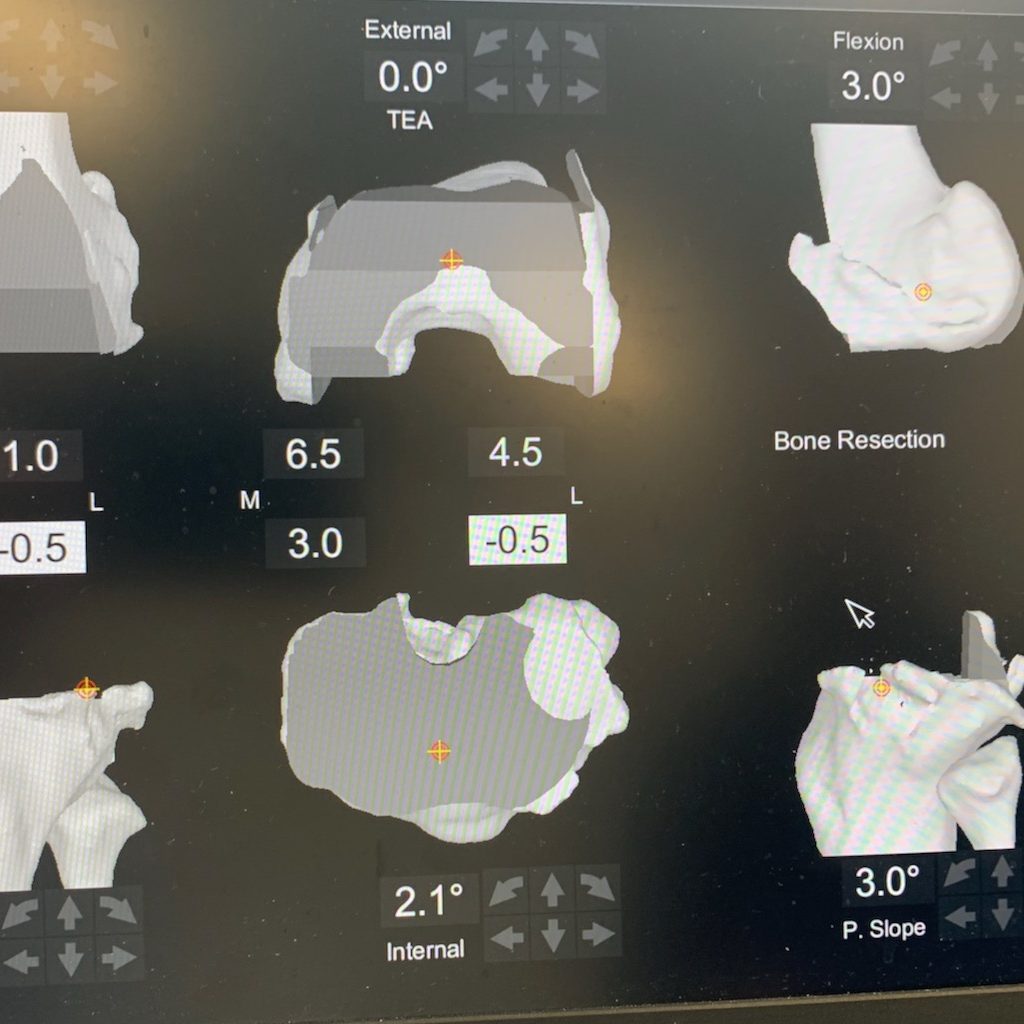
Some robotic platforms require a CT scan. The scan is used to create a three-dimensional model of your hip or knee. Your surgeon can review the shape and size of the bones and plan the intended implant position before the day of surgery.
The plan may include:
- Implant size
- Depth and orientation of bone preparation
- Hip socket position
- Femoral component position
- Knee alignment
- Joint-line position
- Expected leg length or offset in hip replacement
- Expected bone removal
A digital plan is not fixed beyond change. Your surgeon reviews it and can adjust it before or during surgery according to your anatomy, ligament balance and findings at the operation.
Image-free and intra-operative planning
Not every robotic system requires a CT scan. Some platforms create a model using anatomical points and movement data collected after the joint has been exposed.
The surgeon registers specific landmarks so the computer understands the position of the bone and instruments. The system can then provide navigation or robotic guidance based on the plan created during the procedure.
Registration during surgery
The digital model must be accurately matched to your actual anatomy before robotic guidance can be used. This process is called registration.
Tracking arrays may be attached temporarily to the bone using small pins. The surgeon touches defined points on the bone with a tracked instrument so the computer can align the digital model with the joint.
Registration accuracy is checked before bone preparation begins. If the surgeon is not satisfied with the match, the landmarks can be registered again or the operation can continue using conventional instruments.
The plan supports the surgeon rather than locking them in. Your surgeon can adjust implant position, alignment and bone preparation during the operation when the live findings suggest that a change would improve stability, movement or soft-tissue balance.
How robotic hip replacement works
A total hip replacement removes the damaged femoral head and resurfaces the hip socket. A metal cup is placed in the pelvis, usually with a liner inside it, and a stem is inserted into the femur with a new ball attached.
In robotic-assisted hip replacement, pre-operative imaging can be used to plan the size and orientation of the components. The operation can be performed through an anterior or posterior approach depending on your anatomy and your surgeon's technique.
Preparing the hip socket
After the damaged femoral head has been removed, the surgeon exposes the acetabulum, or hip socket. The remaining cartilage and a controlled amount of bone are prepared to receive the new cup.
Depending on the system, the robotic arm may guide the reaming instrument within the planned orientation and depth. The surgeon controls the instrument and decides when sufficient preparation has been achieved.
Positioning the cup
The planned cup position considers your anatomy, pelvic orientation and the overall reconstruction. The robotic system may provide real-time information as the surgeon inserts the component.
The aim is to reproduce the selected orientation accurately. Cup position is one factor that can affect hip stability, movement, wear and impingement, but it is not the only factor. Soft-tissue tension, femoral component position, implant choice and patient anatomy also matter.
Leg length and offset
Planning tools may help the surgeon assess anticipated leg length and hip offset. Offset relates to how far the femur sits from the centre of the pelvis and influences muscle tension and hip mechanics.
Perfectly equal leg lengths cannot always be achieved or may not be the safest goal. Stability and appropriate soft-tissue tension take priority. Your surgeon will explain how leg length and offset are considered in your case.
Completing the replacement
The surgeon prepares the femur, inserts trial components and checks movement, stability and leg length. The final components are then inserted and the wound is closed.
The robotic system assists with selected planning and positioning steps. The surgeon continues to perform the exposure, tissue handling, femoral preparation, implant insertion and final assessment.
How robotic knee replacement works
In total knee replacement, damaged surfaces at the end of the femur and top of the tibia are removed and replaced with metal components. A medical-grade polyethylene insert sits between them to create a smooth bearing surface. The kneecap may also be resurfaced where appropriate.
Robotic assistance helps the surgeon plan and perform the femoral and tibial bone preparation. It may also provide information about alignment, joint gaps and ligament balance through the knee's range of movement.
Assessing alignment and movement
Once the knee is exposed and the system is registered, the surgeon can assess how the joint moves and how tight or loose it is in different positions.
Small adjustments to implant position may then be considered to create an appropriate balance between the inside and outside of the knee. The aim is not necessarily to make every knee conform to one identical alignment target. The plan may be adapted to the patient's anatomy, deformity, ligament function and the surgeon's chosen alignment philosophy.
Preparing the bone
The robotic arm or controlled cutting system helps guide the surgical instrument according to the plan. Some systems create a boundary that restricts where the saw or burr can operate.
The surgeon remains in direct control and can stop, reposition or modify the plan. The robotic system does not begin or continue cutting independently.
Soft-tissue balance
A knee replacement needs appropriate balance as well as accurate bone preparation. If the tissues are too tight or too loose, movement, stability and comfort may be affected.
Robotic systems can provide measurements that help the surgeon understand the spaces between the bones at different points through the range of movement. This information may reduce the need for some ligament releases in selected knees, although releases can still be necessary when deformity or stiffness cannot be corrected through component position alone.
Trial and final components
Trial components are inserted so the surgeon can assess movement, stability, alignment and patellar tracking. Further adjustments can be made when needed before the final components are implanted.
The surgeon completes the operation by controlling bleeding, checking the joint, closing the tissues and applying a dressing.
Robotic partial knee replacement
A partial knee replacement replaces only the compartment affected by arthritis. It may be considered when the disease is limited to one part of the knee and the remaining compartments and ligaments are suitable to preserve.
Because the operation preserves more natural bone and tissue, accurate implant position is important. Robotic planning can help map the affected compartment and guide controlled bone preparation while preserving surrounding structures.
The technology does not make an unsuitable knee suitable for partial replacement. Careful patient selection remains essential. If arthritis is widespread, the knee is unstable or other compartments are significantly damaged, a total knee replacement may be more appropriate.
Read more about partial knee replacement suitability, surgery and recovery.
The procedure: what happens
Preparing for surgery
Preparation for robotic-assisted replacement is broadly the same as preparation for conventional hip or knee replacement. You will have a medical assessment, medication review and anaesthetic planning. Additional imaging may be required for the robotic system.
Where appropriate, we recommend pre-operative rehabilitation. Improving strength, movement, walking capacity and confidence before surgery can make the early post-operative period easier to manage.
Your preparation may include:
- Strengthening the muscles around the hip or knee
- Practising exercises you will use after surgery
- Learning to use crutches or a walking aid
- Reviewing medications and medical conditions
- Stopping smoking and nicotine
- Planning transport and help at home
- Preparing meals and frequently used household items
- Reducing trip hazards
- Planning leave from work
On the day of surgery
The hospital will confirm your admission and fasting instructions. Follow the individual instructions provided by your surgeon, hospital and anaesthetist, particularly for blood-thinning and diabetes medication.
Your surgeon will confirm the procedure and mark the correct side. The theatre team performs formal safety checks before the operation begins.
Joint replacement may be performed under spinal or general anaesthesia. Your anaesthetist may also recommend a nerve block, local anaesthetic or other pain-management techniques.
During surgery
The surgeon exposes the joint through the selected surgical approach. Tracking arrays or sensors are attached where required, and the joint is registered with the computer system.
The pre-operative or intra-operative plan is reviewed against the live anatomy. The surgeon may make adjustments based on joint movement, stability, bone quality and soft-tissue balance.
The robotic system is brought into position for the relevant bone-preparation steps. The surgeon controls the cutting or preparation tool and remains responsible for its movement.
Once the bone has been prepared, the surgeon inserts trial components and checks the joint. The final implants are positioned when the surgeon is satisfied with alignment, stability and movement.
The tracking equipment is removed, the wound is closed and a dressing is applied. The operation then proceeds through the same recovery pathway as a conventional joint replacement.
If the robotic system cannot be used
Occasionally, registration may not be sufficiently accurate, tracking may be interrupted or another technical issue may prevent robotic assistance from continuing.
Your surgeon is trained to complete the operation with conventional instruments if required. Conversion to conventional technique does not mean that the joint replacement itself has failed. It means the surgeon has chosen the safest available method to complete the planned operation.
After surgery
You will wake in the recovery area, where your breathing, circulation, pain and general condition are monitored. Once you are medically stable, you will return to the ward.
Most patients are encouraged to stand and begin walking early with assistance from a physiotherapist. The amount of weight you can place through the leg depends on the operation and your surgeon's instructions, although full weight-bearing is commonly allowed after routine primary hip and knee replacement.
Hospital stay varies. Some suitable patients may leave on the day of surgery or the following day, while others need several nights. Discharge depends on medical stability, pain control, safe walking, home support and the complexity of the procedure rather than whether a robot was used.
When to seek help. Contact MTP Health or seek urgent assessment if you develop fever, spreading redness, persistent wound discharge, increasing calf pain or swelling, chest pain, shortness of breath, sudden loss of movement, severe uncontrolled pain or a significant fall. Concerned about your recovery? Call (02) 9437 9794.
Robotic joint replacement recovery and rehabilitation
Recovery from robotic-assisted joint replacement is broadly similar to recovery from conventional replacement. The operation still involves removing damaged bone, inserting implants and allowing the surrounding muscles and tissues to recover.
Robotic assistance may help the surgeon carry out the plan accurately, but it does not remove the need for pain management, wound care, walking practice, exercise and gradual rebuilding of strength.
Your recovery will depend on:
- Whether you had hip, total knee or partial knee replacement
- Your age and general health
- Your strength and mobility before surgery
- The severity of arthritis and deformity
- Previous surgery
- Pain, swelling and wound healing
- Your home environment and support
- Consistency with rehabilitation
- Your work, driving and activity goals
General recovery timeline
| Phase | Timeframe | What to expect |
|---|---|---|
| Mobilise & settle | Days 0–14 | Walking with an aid, wound care, pain and swelling management, prescribed exercises and safe movement at home |
| Early independence | Weeks 2–6 | Increasing walking, reducing aids when safe, improving movement and regaining confidence with everyday activities |
| Strength & control | Weeks 6–12 | Progressive strengthening, balance work, cycling or pool exercise and return to more normal routines |
| Return to activity | Months 3–6 | Longer walks, gym-based strength work and gradual return to suitable recreational activity |
| Ongoing recovery | Months 6–12 | Further improvement in strength, endurance, confidence, swelling and comfort |
This is a general guide covering hip and knee replacement. Your individual timeline may be shorter or longer, and the instructions from your surgeon and rehabilitation team take priority.
The first two weeks
The early priorities are controlling pain and swelling, protecting the wound, walking safely and completing your prescribed exercises.
You may use a walker, crutches or a walking stick for support. The goal is not to discard the aid as quickly as possible. It is to walk safely and with good control before progressing.
Short, regular periods of movement are usually more helpful than one long period of activity. Rest is also important, particularly after knee replacement where swelling can increase after busy days.
Weeks two to six
Walking distance and everyday independence generally improve. You may begin reducing your walking aid as your strength, control and confidence return.
Hip precautions, where required, depend on the surgical approach, implant stability and your surgeon's protocol. Knee rehabilitation focuses on restoring movement, improving quadriceps control and walking more normally.
Many patients can manage most basic activities by approximately six weeks, although swelling, stiffness, fatigue and sleep disturbance can continue.
Weeks six to twelve
Rehabilitation progresses towards strength, balance, endurance and more demanding daily tasks. Exercise may include cycling, pool-based rehabilitation, resistance training, step work and longer walks.
By this stage, the focus shifts from simply recovering from the operation to restoring the physical capacity needed for work, recreation and long-term joint health.
Three to twelve months
Most improvement occurs during the first several months, but the joint can continue changing for up to a year or longer. Strength, confidence and endurance often improve after the initial pain has settled.
A knee may remain warm or mildly swollen after activity for several months. A hip can feel weak or easily fatigued while the muscles recover. These symptoms should gradually improve rather than becoming progressively worse.
Rehabilitation at MTP Health
This is where MTP Health is different. Your rehabilitation can be delivered by physiotherapists and exercise physiologists working in the same clinic as your orthopaedic team. Your plan can begin before surgery and continue through the early recovery, strengthening and return-to-activity stages.
Rehabilitation focuses on:
- Managing pain and swelling
- Restoring joint movement
- Improving walking quality
- Rebuilding hip, thigh and trunk strength
- Improving balance and confidence
- Returning safely to work and driving
- Preparing for suitable recreational activity
- Building a sustainable long-term exercise routine
Your recovery may be supported by our pre-operative rehabilitation, post-operative rehabilitation, physiotherapy and exercise physiology services.
Technology helps with the plan; rehabilitation helps you use the joint. Accurate implant positioning is one part of a successful joint replacement. Regaining movement, strength, walking capacity and confidence still requires time and structured rehabilitation.
Returning to driving, work and activity
Driving
Return to driving depends on the joint and side operated on, your movement, strength, reaction time and medication use.
You must be able to enter and exit the vehicle safely, control the pedals, steer, check blind spots and perform an emergency stop. You must also be free from medication that impairs alertness or reaction time.
After right-sided hip or knee replacement, driving commonly takes longer because the operated leg controls the accelerator and brake. A left-sided replacement may allow an earlier return in an automatic car.
There is no single date that applies to everyone. Discuss driving with your surgeon and check your motor insurer's requirements before returning.
Desk-based work
Desk-based work may be possible within approximately two to six weeks depending on pain, swelling, fatigue, transport and how long you need to sit.
Working from home, shorter days, regular movement breaks and a staged return can help. Knee replacement patients may need opportunities to elevate the leg, while hip replacement patients may need to avoid prolonged or unsuitable sitting positions early in recovery.
Physical work
Work involving prolonged standing, lifting, climbing, kneeling, squatting or uneven ground usually requires more recovery. A return may take six to twelve weeks or several months depending on the demands.
Your rehabilitation team can assess strength and function and build a work-conditioning program. Heavy or safety-critical work should not resume until you can perform the necessary tasks reliably.
Walking and exercise
Walking begins early and progresses gradually. The aim is to improve distance without creating an excessive increase in pain, swelling or limping.
Stationary cycling is often introduced during rehabilitation when joint movement allows. Swimming and pool exercise can begin after the wound is fully healed and your surgeon has confirmed that immersion is safe.
Sport
Low-impact activities such as walking, cycling, swimming, golf and suitable gym exercise are common goals after joint replacement.
Running, jumping and high-impact sport place greater repetitive forces through the implant. Whether these activities are appropriate depends on the joint, implant, previous experience and individual circumstances. Discuss your goals with your surgeon before returning.
Risks of robotic joint replacement
Robotic-assisted joint replacement carries the same general risks as conventional hip or knee replacement. The robotic system does not remove the possibility of complications.
General surgical and anaesthetic risks
- Infection
- Bleeding or haematoma
- Blood clots in the leg or lungs
- Wound-healing problems
- Medication or anaesthetic reactions
- Heart, lung, kidney or neurological complications
Joint replacement risks
- Persistent pain or stiffness
- Nerve or blood vessel injury
- Fracture
- Implant loosening, wear or failure
- Joint instability or dislocation
- Leg-length difference after hip replacement
- Ligament or tendon injury
- Kneecap problems after knee replacement
- Reduced movement
- The need for manipulation or further surgery
- Revision joint replacement in the future
Risks specific to robotic assistance
- Fracture around a tracking-pin site
- Pin-site infection, pain or irritation
- Injury related to tracker placement
- Failure or loss of tracking during the procedure
- Inaccurate registration of the joint
- Technical or software problems
- The need to abandon robotic assistance and continue conventionally
- Additional radiation exposure when CT-based planning is required
These robotic-specific complications are uncommon, but they should still be understood. Your surgeon will discuss how the general and procedure-specific risks apply to your health, anatomy and planned operation.
Robotic joint replacement cost in Sydney
The cost of robotic joint replacement depends on the operation, hospital, robotic platform, private health cover, surgeon fee, anaesthetist fee, assistant fee and any excess or co-payment on your policy.
The overall cost can include:
- Orthopaedic consultation and imaging
- CT scanning where required for robotic planning
- Surgeon and surgical assistant fees
- Anaesthetist fees
- Hospital and theatre charges
- The joint replacement implant
- Robotic equipment or consumables where applicable
- Medication and post-operative equipment
- Physiotherapy and exercise physiology
If you have private health insurance, the amount covered depends on your policy, waiting periods, exclusions and hospital agreement. Medicare and your health fund may contribute to professional fees, but a gap can remain.
The anaesthetist is an independent practitioner and provides a separate estimate. Your hospital may also charge an excess or co-payment.
Robotic assistance is not always charged as a separate patient fee, but this varies between hospitals, surgeons and health funds. Ask for written informed financial consent before committing to surgery.
If surgery is performed through the public system, there may be no out-of-pocket surgical fee, but access to a particular surgeon, implant or robotic platform is not guaranteed and waiting times depend on local availability and urgency.
Why have robotic joint replacement at MTP Health?
MTP Health brings together orthopaedic surgery, physiotherapy and exercise physiology in one clinical team. This matters because robotic technology is only one part of a successful joint replacement journey.
Before recommending surgery, we assess whether the joint replacement itself is appropriate and whether more non-surgical treatment could still help. If surgery is the right step, we explain the robotic and conventional options without treating technology as a promise of a perfect result.
Your plan can include:
- Careful assessment and imaging
- Honest discussion of non-surgical options
- Individualised surgical planning
- Robotic or computer-assisted surgery where appropriate
- Pre-operative strength and movement preparation
- Early post-operative physiotherapy
- Progressive exercise physiology
- A structured return to work and activity
The aim is not simply to use advanced equipment. It is to combine appropriate technology with good surgery, clear communication and rehabilitation that reflects what you want to return to.
Your surgeon

Dr Donald Cawthorne
Dr Donald Cawthorne is a hip and knee orthopaedic surgeon whose clinical interests include robotic and computer-assisted hip replacement through anterior and posterior approaches, robotic and computer-assisted knee replacement, primary joint replacement and sports knee surgery.
Dr Cawthorne works alongside MTP Health's physiotherapy and exercise physiology team so surgical planning, preparation and rehabilitation can be managed as one coordinated journey.
View full profile →Frequently asked questions
What is robotic joint replacement surgery?
Robotic joint replacement is one of the more recent technologies used during selected total hip, total knee and partial knee replacements. It combines digital planning with computer-assisted guidance and a surgeon-controlled robotic system.
Depending on the platform, planning may use X-rays, a CT scan or measurements collected during surgery. This information helps create a model of the joint and map the intended implant size, position and alignment.
During surgery, the robotic system helps the surgeon reproduce selected parts of that plan. It may guide a cutting device, control a burr within a defined area or provide real-time information about alignment and joint balance.
The aim is to support accurate and reproducible implant positioning as one part of your overall treatment. The technology does not replace the need for appropriate patient selection, good surgical technique or rehabilitation.
Does a robot actually perform the surgery?
No. It is more accurate to describe the procedure as robotic-assisted surgery.
Your specialist orthopaedic surgeon performs the operation and remains in control throughout. The robotic system does not make decisions, move independently or carry out the replacement without the surgeon.
The surgeon:
- Decides whether joint replacement is appropriate
- Selects the surgical approach and implant
- Reviews and adjusts the digital plan
- Exposes the joint and protects the tissues
- Controls the robotic cutting or preparation tool
- Checks movement, stability and alignment
- Inserts the final components
- Completes and closes the operation
The robotic arm is brought into use only for relevant parts of the procedure. The system helps guide the instrument according to the plan, but the surgeon controls when and how it is used.
How does the robotic arm help during hip and knee replacements?
The role of the robotic system differs between hip and knee replacement.
During hip replacement
The system may help guide preparation of the hip socket and assist the surgeon in placing the cup according to the planned orientation and depth. Planning tools can also help assess component size, anticipated leg length and hip offset.
The surgeon still prepares the femur, chooses the final components, tests stability and completes the replacement.
During knee replacement
The robotic system may help guide preparation of the femur and tibia according to the planned alignment. It can also provide information about joint movement and the balance of the surrounding ligaments.
The surgeon can adjust the plan during the operation and remains in control of the cutting device. The goal is to match the surgical plan as closely as is appropriate while creating a stable and functional joint.
How is robotic joint replacement surgery planned?
Planning begins with a consultation, clinical examination and X-rays. Your surgeon first determines whether joint replacement is appropriate and whether robotic assistance is suitable for the planned procedure.
Some robotic systems require a CT scan, which is used to build a three-dimensional model of your joint. Your surgeon can use the model to plan implant size, position, alignment and the amount of bone preparation required.
Other systems are described as image-free. They create or refine the plan using anatomical landmarks and movement information collected during surgery.
During the operation, the digital model is matched to your actual joint through a process called registration. Tracking sensors allow the system to understand the position of the bones and instruments.
Your surgeon checks that the registration is accurate before using robotic guidance. The plan can be adjusted according to the live anatomy, movement and soft-tissue balance found during surgery.
What are the potential benefits of robotic-assisted surgery?
The main potential benefit is the ability to plan and perform selected technical parts of a joint replacement with a high degree of precision and reproducibility.
Potential advantages may include:
- Detailed three-dimensional planning
- Accurate reproduction of planned bone preparation
- Real-time feedback about implant position and alignment
- Assessment of knee movement and ligament balance
- Controlled boundaries around the cutting or preparation tool
- The ability to make measured adjustments during surgery
- Potentially reducing some soft-tissue releases in selected knee replacements
These are technical benefits rather than guaranteed patient outcomes. More precise alignment does not automatically mean less pain, faster recovery or a longer-lasting implant for every patient.
Research comparing robotic-assisted and conventional replacement continues. Your surgeon can explain what the technology may add in your circumstances and whether those potential advantages justify its use.
Is recovery different from conventional joint replacement?
For most patients, the pre-operative and post-operative pathway is broadly similar to conventional hip or knee replacement.
You will still need:
- Medical and anaesthetic assessment
- Wound care
- Pain and swelling management
- Early walking with an aid where required
- Exercises to restore movement
- Progressive strengthening
- A gradual return to driving, work and activity
Some studies suggest robotic-assisted surgery may improve certain early recovery measures, but this is not consistent across all patients or procedures. The joint being replaced, the overall operation, your health and your rehabilitation have a greater influence on recovery than robotic assistance alone.
Joint replacement remains significant surgery. Strength, confidence and comfort continue improving for several months, and some symptoms can take a year or longer to settle fully.
Is robotic joint replacement better than conventional surgery?
Robotic-assisted surgery is not automatically better for every patient. It offers additional planning and guidance that may help the surgeon reproduce the intended implant position accurately.
Conventional joint replacement is also a well-established treatment with strong long-term results. Experienced surgeons can perform successful hip and knee replacements without robotic assistance.
Research has shown technical improvements in areas such as alignment accuracy, but clear and consistent improvements in pain, function, complications or implant survival have not been demonstrated for every patient.
The better option is the one that suits your diagnosis, anatomy, implant requirements and surgeon's experience.
Can robotic assistance be used for both hip and knee replacement?
Yes. Robotic systems are available for total hip replacement, total knee replacement and partial knee replacement.
Not every platform performs every operation, and different systems may only be compatible with particular implants. Availability also varies between hospitals.
Your surgeon will explain whether a robotic system is available and appropriate for the type of replacement you need.
Do I need a CT scan for robotic joint replacement?
Some robotic systems require a pre-operative CT scan to create a three-dimensional model of your hip or knee. Other systems use X-rays or information collected during surgery and do not require CT-based planning.
If a CT scan is required, your surgeon will arrange it and explain how it is used. The scan involves radiation exposure, which is one of the factors considered when choosing the technology.
Does robotic surgery use a different implant?
The implant may be the same type used in conventional joint replacement, but robotic platforms are often designed to work with a particular manufacturer's implant range.
Your surgeon should choose an implant based on your anatomy, diagnosis and clinical needs rather than selecting it only because it is compatible with a robot.
Ask your surgeon which implant is planned, why it is suitable and whether the robotic system limits the available choices.
What happens if the robotic system stops working during surgery?
Technical problems are uncommon, but the robotic system may occasionally be unavailable or unable to continue because of registration, tracking, equipment or software issues.
Your surgeon can complete the joint replacement using conventional instruments if necessary. Surgeons who use robotic technology remain trained in the conventional procedure and prepare for this possibility.
Changing to conventional instruments does not mean the joint replacement has failed. It means the surgeon has selected the safest practical way to complete the operation.
What are the risks of robotic joint replacement?
Robotic joint replacement carries the same general risks as conventional hip or knee replacement. These include infection, bleeding, blood clots, wound problems, fracture, nerve or blood vessel injury, stiffness, persistent pain, implant loosening and the possibility of further surgery.
Hip-specific risks include dislocation, leg-length difference and injury to muscles or tendons. Knee-specific risks include stiffness, ligament problems, kneecap symptoms and reduced movement.
Additional risks associated with robotic systems can include:
- Pain, irritation, infection or fracture around a tracking-pin site
- Inaccurate registration
- Loss of tracking
- Equipment or software problems
- The need to continue with conventional instruments
- Radiation exposure from a planning CT scan where required
Your surgeon will discuss the risks that apply to your health, joint and planned procedure.
How long does robotic joint replacement take?
The duration depends on whether you are having hip, total knee or partial knee replacement, as well as the complexity of the operation.
Robotic registration and setup add steps to the procedure, particularly while the surgical team is becoming familiar with a platform. In an experienced team, the overall operating time may be similar to conventional replacement.
Your relatives should allow additional time for anaesthesia, positioning and recovery rather than using the surgical time alone to estimate when you will return to the ward.
How long will I stay in hospital?
Hospital stay is determined by your medical condition, pain control, mobility, home support and the operation performed.
Some suitable patients can leave on the day of surgery or the following day. Other patients need two or more nights. Robotic assistance alone does not determine when discharge is safe.
Before leaving hospital, you should be medically stable, able to manage the required walking and transfers, and have an appropriate plan for medication, wound care and rehabilitation.
How much does robotic joint replacement cost?
The cost depends on the joint being replaced, hospital, surgeon, anaesthetist, implant, robotic system and your private health insurance.
A CT scan may add a separate cost when required for planning. Some hospitals absorb the robotic technology into the overall theatre charge, while others may have different arrangements.
Before surgery, request written estimates from:
- Your surgeon
- Your anaesthetist
- The hospital
- Your health insurer
- The imaging provider where a CT scan is required
MTP Health will help you understand the expected surgical pathway, but fees from independent providers must be confirmed directly with them.
Robotic joint replacement consultations across Sydney
```North Shore Health Hub, Level 4, Suite 401, 7 Westbourne St, St Leonards NSW 2065
St Leonards consulting →173 Warringah Road, Beacon Hill NSW 2100 — serving the Northern Beaches
Beacon Hill consulting →Also consulting at Gosford, Wahroonga, Castle Towers and Tamworth.
Talk to a surgeon about robotic joint replacement
```Book a consultation to find out whether you need a hip or knee replacement, whether robotic assistance is appropriate and what your preparation and rehabilitation would involve.
Book a ConsultationPrefer to talk? Call (02) 9437 9794 · GP & physio referrals: referrer information
```- American Academy of Orthopaedic Surgeons, patient and clinical guidance on robotic-assisted joint replacement.
- National Institute for Health and Care Excellence, HealthTech guidance on robot-assisted orthopaedic surgery.
- Australian Orthopaedic Association National Joint Replacement Registry, annual reports and research on hip and knee arthroplasty outcomes.
- Current peer-reviewed literature comparing robotic-assisted and conventional hip and knee replacement.
Robotic Joint Replacement Surgery
The most recent technological advance in attempting to improve results from Total Hip and Knee replacements..
Robotic Joint replacement surgery relies on a combination of pre-operative planning (Xrays and CT scans) with computer-assisted alignment and a surgeon-controlled robotic ‘arm’ to precisely make cuts in the bone.
About Robotic Joint Replacement Surgery
Robotic Joint replacement surgery is the most recent technological advance in attempting to improve results from Total Hip and Knee replacements. It relies on a combination of pre-operative planning (Xrays and CT scans) with computer-assisted alignment and a surgeon-controlled robotic ‘arm’ to precisely make cuts in the bone.
Robotic surgery in Orthopaedics is better described as robotic-assisted surgery, as it involves a robotic arm to control a cutting device for the bone only. The surgeon still performs all parts of the operation, however, once the bone is to be cut, the robotic arm is brought into place to assist the surgeon to cut in a precise, pre-determined alignment.
Hip Replacement surgery: The robotic arm allows the surgeon to align the cutting device for the ‘cup’ of the hip joint to the desired position based on the pre-operative planning.
Knee Replacement surgery: The robotic arm with the cutting blade ensures the alignment of the surgical bone cuts on both sides of the knee joint are in the pre-operatively planned position.
According to the Knee Society of Australia, Robotic-assisted Partial knee replacements have shown good results over the past 2 years however, long-term results are still not available due to Robotic surgery being newer than the conventional types of surgery. Results of Robotic-assisted Total Hip and Total Knee replacement are unclear at this stage, again due to its recent introduction
The pre-operative and post-operative course following Robotically assisted surgery is no different to that following conventional knee and hip replacement.
At this point in time in NSW, Robotic joint replacement surgery is mostly only available in the private hospital setting due to cost limitations.