
Total Knee Replacement in Sydney
When knee arthritis no longer responds to non-surgical care, a total knee replacement can reliably restore comfort and movement — planned with robotic assistance and supported by rehabilitation under the same roof.
What is a total knee replacement?
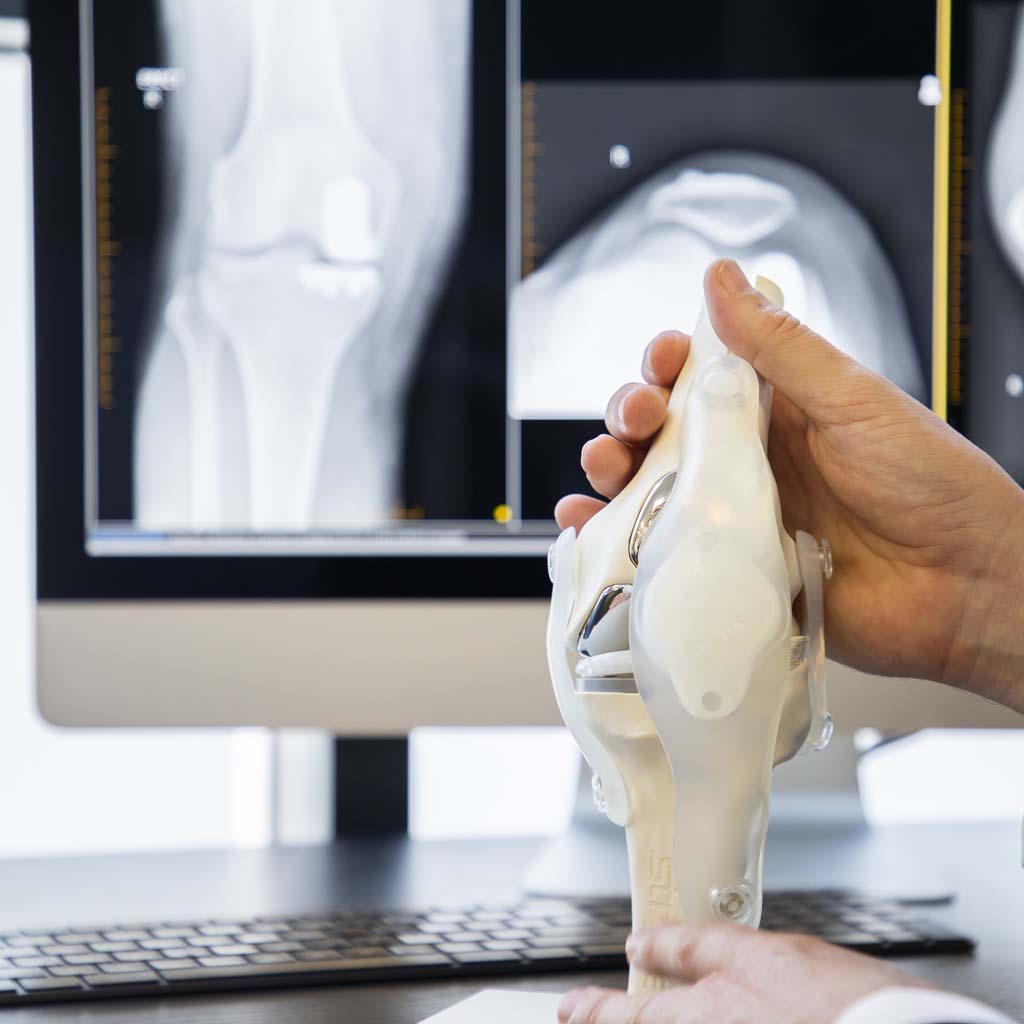
A total knee replacement is surgery to resurface a knee joint that has been worn down by arthritis. The damaged ends of the thigh bone and shin bone are removed and replaced with metal and medical-grade plastic components that recreate a smooth, pain-free surface — allowing the joint to move freely again.
The kneecap surface may also be resurfaced. At MTP Health, the procedure is often planned using robotic-assisted knee replacement technology, which builds a model of your knee from imaging and helps position the implant precisely for your anatomy. It is one of the most reliable and well-studied operations in orthopaedics.

Do you need a knee replacement?
A knee replacement is usually considered for advanced knee osteoarthritis — when the cartilage has worn to the point that bone rubs on bone. The typical signs are persistent pain that disturbs sleep, stiffness, swelling, and difficulty with everyday activities like walking, stairs and getting out of a chair, despite good non-surgical treatment. Depending on the pattern of joint wear, a partial knee replacement may also be considered.
Not sure it has come to surgery? For most people with knee arthritis, the right first step is exercise-based treatment and weight management, not an operation. Our Osteoarthritis Clinic and physiotherapy team can assess your knee and often relieve symptoms without surgery — and if surgery is eventually needed, you will already know your team.
Surgery becomes the reasonable choice when pain and loss of function persist despite this care, and when arthritis is affecting your quality of life. There is no single "right age" — the decision is based on your symptoms, your imaging and what you want to get back to, discussed honestly at your consultation.
Benefits and risks
What you can expect it to achieve
- Reliable, lasting relief from arthritic knee pain for the large majority of people
- Restored movement and the ability to return to walking, stairs, travel and low-impact activity
- Correction of bowing or knock-knee deformity caused by uneven joint wear
- A durable result — more than 90% of total knee replacements are still working at 15 years1
Risks to understand
- Common and temporary: swelling, bruising and stiffness in the early weeks, which settle with rehabilitation
- Uncommon: infection around 1%, blood clots in the leg or lung, and wound-healing problems — all of which we actively work to prevent
- Longer-term: implants can eventually wear or loosen and may one day need revision knee replacement
- Satisfaction: most people are pleased with the result, but around 1 in 10 do not feel fully satisfied, most often because some stiffness or aching remains2
All knee surgery carries risk and outcomes vary between individuals. Dr Jonathan Negus will discuss how these risks apply specifically to you, and how we reduce them through careful planning, robotic-assisted accuracy and structured rehabilitation before and after surgery.
The procedure: what happens
You will have a pre-operative assessment and imaging, and we will optimise your health for surgery. Where it helps, we recommend pre-operative rehabilitation — building the strength around your knee before surgery measurably supports your recovery afterwards.
The operation takes around one to two hours under general or spinal anaesthesia. Dr Negus removes the worn joint surfaces and fits the implant, using robotic-assisted guidance where appropriate to position it accurately and balance the soft tissues.

After surgery
You will usually stay in hospital for one to four nights, with pain managed through a combination of medications and your knee moving early. Physiotherapy begins in hospital and continues once you are home, and your first follow-up review is arranged before you leave.
When to seek help. Contact us or seek urgent care if you develop a fever, increasing calf pain or swelling, spreading redness or discharge from the wound, or pain that your medication is not controlling — these can be early signs of infection or a clot. Concerned about your recovery? Call (02) 9437 9794.
Total knee replacement recovery and rehabilitation
Most people walk with support within a day of surgery, return to desk work by around six weeks, and continue improving for six to twelve months as strength and confidence return. Recovery is gradual and steady rather than dramatic — and how well you rehabilitate has as much bearing on the result as the surgery itself.
Recovery timeline
| Phase | Timeframe | What to expect |
|---|---|---|
| Protect & settle | Weeks 0–2 | Walking with aids from day one, wound healing, managing swelling, gentle range-of-motion exercises |
| Early movement | Weeks 2–6 | Bending the knee further, walking further, weaning off aids, most people back to desk work |
| Strength | Weeks 6–12 | Building strength, resuming most daily activities, driving usually resumes, swelling reducing |
| Return to activity | Months 3–6 | Low-impact activity such as walking, cycling, golf and swimming; ongoing strengthening |
| Full function | Months 6–12 | Final result settles as soft tissue and residual swelling resolve |
Timeframes are a guide — your surgeon and rehab team set milestones based on your progress, not the calendar.
Post-operative care
In the first weeks at home the priorities are keeping the wound clean and dry, controlling swelling with elevation and ice, staying on top of pain relief so you can move comfortably, and doing your prescribed exercises. Simple blood-clot prevention and gradually increasing your walking are part of the plan, and we review you regularly to keep recovery on track.
Rehabilitation at MTP Health
This is where MTP Health is different. Your rehabilitation is delivered by our own physiotherapists and exercise physiologists, in the same clinic as your surgeon, following a plan that often begins before surgery and continues seamlessly afterwards. There is no hand-off to an outside provider — the same team, working from one shared record, guides you from prehab through to full recovery.
Rehabilitation focuses on restoring range of motion early, then progressively strengthening the muscles that support the knee and rebuilding the confidence to move well. Your recovery is supported by our post-operative rehabilitation, physiotherapy and exercise physiology services.
Returning to work, driving and sport
Desk-based work is usually possible from around four to six weeks, and physical work later depending on demands. Most people return to driving at about six weeks, once off strong pain relief and able to brake safely. Low-impact sport typically returns by three to six months. These are guides — timing varies with the individual, and running and high-impact sport are generally discouraged to protect the implant.
Rehab is half the result. The evidence is clear that structured rehabilitation drives the outcome as much as the surgery — and at MTP Health it happens under the same roof, with the same team that planned your operation.
Total knee replacement cost in Sydney
The total cost of a knee replacement is made up of several fees — the surgeon, the anaesthetist, the hospital and the implant. What you actually pay out of pocket depends on your private health cover and level of hospital insurance. With appropriate cover, your health fund and Medicare contribute to the hospital, implant and medical fees, leaving a smaller gap payment.
You will always receive a written quote setting out any out-of-pocket cost before you decide to proceed — there are no surprises. For a fuller breakdown of how the fees work, including the public and private pathways, see our knee and hip replacement cost guide.
Why have your knee replacement at MTP Health
MTP Health brings together fellowship-trained orthopaedic surgeons, robotic-assisted technology, and a physiotherapy and exercise physiology team in one clinic. It means your surgery is planned precisely and your recovery is led by the same people who planned it — the integrated model that sets MTP apart from a surgeon-only practice. Honest advice comes first: if a knee replacement is not yet the right step, you will be told so.
Your surgeon

Dr Jonathan Negus
Dr Negus is a fellowship-trained hip and knee surgeon with a particular focus on joint replacement, including robotic-assisted total knee replacement. He works alongside MTP Health's physiotherapy and exercise physiology team so your surgery and rehabilitation are managed as one plan.
View full profile →Frequently asked questions
What is total knee replacement surgery?
Total knee replacement surgery is a common surgery which relieves the pain of severe knee arthritis.
You are most likely to benefit from total knee replacement surgery if you are experiencing:
- Arthritis pain which is significantly affecting your ability to:
- carry out normal daily activities
- walking to the shops
- playing golf, tennis or go bowling
- get a good night’s sleep.
- Pain even though you have tried combinations of:
- Pain-killers
- Anti-inflammatories
- Physiotherapy
- weight loss
- Changing your activities.
The aim of total knee replacement surgery is relieve your pain and give you a knee that you can trust while you get back to the activities that make you happy.
How can I best prepare for a knee replacement?
A total knee replacement surgery is rarely an urgent surgery and results are generally better with proper preparation. It is vital that you work with your physiotherapist to maximise your range of motion and hip strength to be prepared for the rehab and recovery. Our MTP Health Knee programs can help you with this.
It is important to consider the rehabilitation and recovery time from the surgery and what effect the timing of surgery will have on:
- Family events and holidays
- Work trips or busy periods
At MTP Health, we take your preparation for surgery very seriously. It is our policy to prepare you over a minimum period of 4-6 weeks in order to ensure that you get the best outcome through being psychologically prepared, physically strong and medically safe enough to undergo this procedure.
These tests will include:
- Planning imaging including a CT scan
- Routine blood tests
- Swabs for MRSA
If there are any specific concerns or medical issues, we will ensure that they are optimised prior to the surgery and to do this we will also organise for you to be seen by:
- A cardiologist to ensure there are no issues with your heart during the anaesthetic
- Any other of your treating physicians, e.g. for your diabetes or lung conditions
Finally and importantly, we will help you to get strong:
- Our team of physiotherapists and exercise physiologists will assess your level of function
- You will be given a personal program in the lead up to your operation to make sure you are ready to start recovering as soon as you wake up from the anaesthetic
Please see the “Preparing for joint replacement surgery” for more detail.
What happens before knee replacement surgery?
We need to know about all your medications but especially those for diabetes, blood pressure or blood thinning as we may need you to stop some or all of them up to 1 week before surgery. It is highly recommended that if you are a smoker, that you refrain from smoking for as long as possible prior to surgery to ensure the best outcomes.
You must ensure that your knee area remains free from scratches in the weeks before surgery - NO LAST MINUTE GARDENING. If this occurs, please tell us as it increases your infection risk and your surgery may need to be delayed. This can happen in the anaesthetic bay if we don’t know about it beforehand. If not sure, send us a picture.
The hospital will contact you in the week of surgery and they will confirm with you on the day before your surgery, the time you need to arrive and when you need to start fasting.
For our patients, if you are on a morning list you need to stop all food from midnight and stop clear fluids from 0530 or 2 hours before the planned start of the list, whichever comes first.
For afternoon lists that time is 11am.
Acceptable clear fluids include water, ‘see through’ apple juice with no bits or ‘see through’ energy drink such as Gatorade. It does not include milk or cloudy juice with bits.
What happens during knee replacement surgery?
You will arrive at the hospital between 1 and 2 hours before your surgery. You will have your knee area prepared by a nurse who will shave the skin and paint on a coloured antiseptic solution. You will then meet one of our anaesthetic team. They will make sure you are comfortable and safe during the procedure.
Before your anaesthetic, your surgeon will see you and ask you “Which JOINT and What SIDE?” This is critical as they will then check this matches your consent form and draw an arrow on the knee that you specify and point to. This is the most effective way of stopping ‘Wrong Side surgery.’
At the start of the procedure you are transferred from your nice warm bed to lie on your back on a hard and cold operating table - apologies in advance. The most common anaesthetic for a joint replacement surgery is a spinal block with a light general anaesthetic. This means you will be asleep. A urinary catheter is placed before the operation but this will be removed in recovery in most cases. The surgical team then performs the “Time-out” procedure to double check that your name band, imaging and the arrow drawn on your knee all match with your signed consent form.
The procedure is done under sterile conditions with you lying on your back. The incision will be approximately 10-20 cm down the middle of the knee where we expose the bones of the knee. Using specialised equipment, we then remove the damaged bone and cartilage at the end of the femur (thighbone) and tibia (shin bone). The metal knee components are then fixed into place on both the femur and tibia. A durable polyethylene plastic insert is placed between the metal components to act as a cushion and allow smooth bending of the knee. The new knee will be tested to make sure it is stable and bending correctly before we close your wounds with a dissolvable stitch to minimise scarring. Dressings and a bandage will then be applied to protect the wound for the weeks following the operation.
The surgery takes between 90 minutes to 2 hours on average with additional time before for anaesthetics and after for recovery. For the waiting relatives or partners, it is usually between 3-5 hours from leaving the admissions area to getting back to the ward.
What should I expect immediately after knee replacement surgery?
After the operation, you wake up in the recovery room, where you are monitored for approximately 1 hour. During this time, your surgeon will call your relative. It is important that they realise that this may be more than 4 hours from the time you were ‘taken into the operating theatres’ due to waiting and preparation times.
Once stable, you can be transferred to the ward to begin your post-surgical recovery. The knee replacement that has been placed is strong enough for you to walk on it straight away with all your weight and the team will have you walking within 4 hours of waking up. If you are light headed or nauseated, they will help you to stand and march on the spot.
WALKING - The knee replacement that has been placed is strong enough for you to walk on it straight away with all your weight and the team will have you walking within 4 hours of waking up. If you are light headed or nauseated, they will help you to stand and march on the spot. You are encouraged to bend it as much as you can tolerate.
DRESSINGS - The bulky dressings can be removed the morning after surgery. You will have a waterproof dressing that you should leave on until you have your wound check at 10-14 days. It is common for a small amount of ooze to dry into the dressings over the first 24-48 hours.
You can shower with this dressing but avoid soaking in the bath, a pool or the ocean. If it comes loose or gets soaked, please replace it. We do not allow hydrotherapy within the first 3 weeks of joint replacement surgery until the wound is healed and watertight.
GAME READY - If you have been supplied with a Game Ready machine, we advise that you use it on program 2 or 3 and for up to 2 hours at a time. You can use it as often as you like in a day as long as you manage to complete your rehabilitation exercises. If your pain and swelling are well controlled then you don’t need to use it. When rented from MTP Health you have the Game Ready for 2 weeks. At the end of this time it will be picked up by a courier unless you would like additional rental time.
LENGTH OF STAY - We call the day after surgery ‘Day 1 post surgery.’ Your aim on this first day is to pass all your discharge tests from the hospital physiotherapists and plan for going home. We will organise an x-ray of the knee if not done in recovery and a blood test to check for blood loss and kidney function. It is safe for some to go home on the same day of surgery but more usually, patients stay overnight and possibly a second night.
SURGEON FOLLOW UP
Your first post-operative visit will be with your surgeon at 2 weeks. This appointment is critical for checking your wound healing and to assess your new knee as well as to answer any questions you may have.
Further follow up with your surgeon with x-rays at some visits to check the prosthesis:
- 6 weeks after surgery + XR
- 12 weeks after surgery
- 6 months after surgery
- 1 year after surgery and annually ongoing + XR
What is my rehabilitation following knee replacement surgery?
Your recovery starts the minute you are awake from the anaesthetic. You start with the simple exercises including ‘Pumping’ your calf muscles to encourage blood movement through the legs which will reduce your risk of DVT and contracting your thigh muscles to squash the back of your knee into the bed. The physiotherapist will assist you in getting out of bed and sitting out in a chair. A walking aide such as a tall walking frame is used to help you balance initially and this is progressed quickly to a smaller frame and then crutches, as shown at the Jointworks Preop Joint Clinic.
Your job is to get the physiotherapists to sign you off as ‘READY FOR DISCHARGE HOME’ on DAY 1 which needs you to be safe on crutches and able to climb stairs.
Your main focus in the first 2 weeks following the operation is to take the painkillers you need to be able to do your exercises that will help you get the flexibility back into the knee and strengthen up your thigh muscles again.
Most patients do not need inpatient rehabilitation services but they are very useful for those that live alone or have many stairs to get into their house. We have many options for helping you to successfully rehabilitate at home and we will go through all these in your preparation sessions.
Two weeks following the operation, we will examine your surgical wound and ensure that it is healing well. The dressings can then be removed, and you will be able to shower without covering the wound. The sutures are dissolvable and will not need to be removed.
Six weeks from the operation, we will ask you to get an x-ray where we can check that the prosthesis is still secure and functioning well.
Following your six week review if suitable, your rehabilitation should continue to advance moving into a program such as the MTP Health Knee & Hip Program. This will ensure continued functional improvement to re-establish your strength, balance and coordination and help guide you back to your goal level of function.
When can I return to driving, work and sport after knee replacement surgery?
Returning to work and sport depends on your line of work, recovery speed and reliance on transport.
Work
Office based jobs can be restarted as soon as you are comfortable and no longer taking strong pain killers. Although sitting for long periods may be uncomfortable, there are no restrictions on doing so. It takes longer to return to more physically demanding jobs for healing and safety reasons. Activities such as climbing ladders and carrying heavy loads are to be avoided for a minimum of 12 weeks.
Sport
Return to sport is a gradual process that is guided by your pain levels and recovery progress with physiotherapy. It is also very dependant on the activity you wish to return to. Swimming for example can be restarted after 3 weeks when the surgical wound has healed and you are comfortable, though it is recommended this is supervised or in water in which you can stand initially. More intensive sports such as bush walking, golf etc will take at least 6 weeks to return to and again this is a gradual return. It is not recommended that you run on any knee replacement unless previously discussed with your surgeon.
Driving
It is recommended that you do not recommence driving until you can safely perform an “emergency stop” and are no longer taking strong pain killers. On average, this is a minimum of 2 weeks from a left knee replacement and 6 weeks from a right knee replacement. Please check with your surgeon and your car insurance company.
What are the risks of knee replacement surgery?
All surgery involves a risk of complications. Fortunately, serious complications are uncommon.
In general, the risks during the operation involve those related to the anaesthetic - heart, lung and brain problems which can include allergic reactions, blood loss requiring transfusion, kidney injury, heart attack, stroke and death.
The surgical complications include the general risks of:
- Blood clots (DVT/PE) in the veins (Note to vividus - DR NEGUS to add % to all these - different for each type of surgery)
- Infection and wound breakdown
- Injury to blood vessels
- Injury to nerves
- Damage to the bone including fractures
Specific surgical complications relating to knee replacement include:
- The most common risk is damaging the small branches of the saphenous nerve that supplies the sensation over the front of the knee causing numbness on the outer part of the scar. It usually gets better over time, but in many cases this area remains permanently numb and can cause discomfort when kneeling. It does not cause any muscle weakness.
- Knee stiffness - Nearly all knees are stiff following replacement surgery but some stay stiff even after 2 months and can require further procedures to help them bend again.
- Over time the plastic components can wear out and need replacing.
- The metal components can become loose from the bone needing replacing.
- Dislocation - the kneecap can become unstable or even dislocate following surgery.
- The common peroneal nerve can be damaged by retractors or from straightening up a knee that was very stiff, especially when the arthritis had caused a knock-kneed valgus deformity. Stretching or damaging this nerve damage can lead to ‘foot drop’ and numbness which can be permanent.
- Leg length discrepancy - It is uncommon to change the length of the leg after knee replacement surgery.
How much does knee replacement surgery cost?
As always with the health system, the answer is ‘It depends.’
However, at Jointworks our mission is to simplify healthcare through a better understanding of the system upfront. Therefore, while you can discuss the options specific to you with the team when you see your specialist -
If you are having your surgery using your private health cover then the standard fees for the surgeon, the anaesthetist and the assistant will usually lead to a total out of pocket payment of approximately $4,500-5,000.
This is the ‘GAP’ that is left after Medicare and your insurance company have given you back their rebates. It is important to stress that the anaesthetist is an independent practitioner and can charge a different gap which could affect this figure. We always provide you with their details and recommend you check their quote before committing to surgery.
The surgeons at Jointworks do participate in the various reduced gap schemes run by different health insurance providers. However, please check for availability of surgical time slots first as there is often a wait of many months for this option.
Your insurance may also have an excess to pay so please check. This is usually $500.
If you are having the operation under the public system there is no out of pocket cost. Unfortunately, you are likely to have to wait up to a year for surgery and you MUST LIVE on the NORTHERN BEACHES of Sydney to be eligible.
Knee replacement consultations across Sydney
North Shore Health Hub, Level 4, Suite 401, 7 Westbourne St, St Leonards NSW 2065
St Leonards consulting →173 Warringah Road, Beacon Hill NSW 2100 — serving the Northern Beaches
Beacon Hill consulting →Also consulting at Gosford, Wahroonga, Castle Towers and Tamworth.
Talk to a surgeon about your knee
Book a consultation to find out whether a knee replacement is right for you — and if it isn't yet, to leave with a clear non-surgical plan either way.
Book a ConsultationPrefer to talk? Call (02) 9437 9794 · GP & physio referrals: referrer information
- Australian Orthopaedic Association National Joint Replacement Registry (AOANJRR), Annual Report — total knee replacement survivorship.
- Australian Commission on Safety and Quality in Health Care / peer-reviewed literature on patient-reported outcomes after total knee replacement.