Has anyone ever told you that you have degenerative arthritis?
Leaves quite a visceral image in the mind doesn’t it!
The picture of a chalky bone, crumbling apart like the Cliffs of Dover while the smooth Teflon like cartilage appears jagged and ripped apart. We imagine that with each step we take, the precious cartilaginous ends of our bones are slamming into one another causing more and more damage to appear as if our bones were part of some poorly oiled machine. And this is the narrative that most of us run with when we think of arthritis.
Fortunately, this isn’t quite the case
You see, our body is actually one big ecosystem. An ecosystem that is in a constant state of flux. If we remember back to high school biology, chances are the word homeostasis will be familiar to us. Well, that’s precisely what articulates why the idea of ‘degenerative arthritis’ doesn’t quite tell the whole story. Because our body will always try to achieve homeostasis (return to a baseline), our whole ecosystem (and millions of parts e.g. bones, joints, organs, veins, muscles etc.) will constantly react to the stimulus it faces. When we combine homeostasis with another physiological principle known as Specific Adaptations to Imposed Demands [SAID] we see what actually occurs.
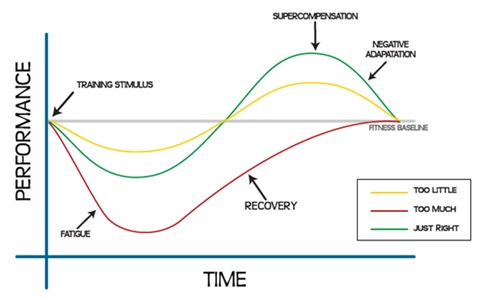
SAID Principle [Specific Adaptations to Imposed Demands] as a diagram – Source: https://www.apki.or.id/specific-adaptations-to-imposed-demands-said/
Now we are not saying that this means the body can miraculously grow back cartilage. Recent evidence has not shown this to be true when it comes to arthritis. What we are saying, however, is that if we don’t do anything to challenge ourselves the rest of our body (muscles, tendons, bone density) will start to become weaker, which will inherently speed up the degenerative nature of our osteoarthritis. Resting and avoiding pain is one of the worst things that can be done for your arthritic condition. In our opinion, a big reason why the condition is called degenerative arthritis is because of the fact that rest and avoidance of pain has so commonly been a recommendation from the medical community at large. Often there is a reason for this, however, in this day and age, more and more evidence is showing the importance of continuing activity in helping improve the condition of arthritis. Plus long term exercise has not been shown to worsen the condition of OA [See our Post with evidence here].
So what are we suggesting?
That you start moving.
Learn how to strengthen your body.
Work with someone who knows how to impart a training stimulus that looks like the green curve instead of the red one.
A big part of work at MTP is learning how to master the art of exercise prescription. There is a reason that all of our practitioners have to study at university for at least 4 years. That reason is because finding exercise that looks like the green line and applying it into someone’s life is difficult. It requires a comprehensive understanding of where that person is at and how they are likely to respond to a certain intervention based on years of clinical research & application.
This is what makes us so passionate about what we do. It’s because we see the difference these changes in mindset make to people’s quality of life and overall happiness.
If you have any further questions or would like us to help you apply this article to you, please don’t hesitate to reach out!
Look forward to seeing you with pain-free knees!
Recent Post
-
Shared Decision Making in Joint Surgery: How to Be an Active Partner in Your Surgery Decision
Key Takeaways Shared decision making pairs your surgeon’s clinical knowledge with what only you know…
-
Slow Recovery After Joint Replacement: How the Treatment Plan Adapts
Key Takeaways Slow recovery after joint replacement is common and often reflects your starting strength,…
-
Trigger Finger and Stiff, Sore Hands: What’s Going On?
Key Takeaways Trigger finger develops when a flexor tendon struggles to glide through a thickened…
-
Bilateral Hip Replacement: Can Both Hips Be Replaced at the Same Time?
Key Takeaways Both hips can be replaced under one anaesthetic, though this suits a narrower…
-
Golf After Hip Replacement: Can I Travel and Play Tennis Again?
Key Takeaways Golf after hip replacement often starts with putting and chipping from around six…
-
Knee Osteotomy: The Surgery That Can Delay a Knee Replacement for Younger Patients
Key Takeaways Knee osteotomy realigns the leg so body weight passes through healthier cartilage, easing…
-
What Is Sciatica and Why Does It Run Down My Leg?
Key Takeaways Sciatica describes pain that starts in the lower back or buttock and travels…
-
Kneecap Dislocation Surgery: When Is MPFL Reconstruction Needed?
Key Takeaways A first kneecap dislocation is usually managed without surgery, with reduction, imaging and…
-
Driving After Knee Replacement, Kneeling and Walking Timeline
Key Takeaways Driving after knee replacement usually resumes once you can brake firmly without hesitation…
-
Best Orthopaedic Surgeon in Sydney: How to Choose the Right One for You
Key Takeaways No clinic can lawfully advertise the ‘best orthopaedic surgeon in Sydney’, so rankings…