ACL Reconstruction Rehab in Sydney: Back to Four Sports
A man in his early 50s ruptured his right ACL in a fall while skiing. Nine months later he was surfing, running, skiing and playing tennis again — with every progression along the way decided by testing data rather than the calendar.
1.6%Quadriceps side-to-side difference at discharge
4 sportsSurfing, running, skiing, tennis
A fall on a ski slope takes a second. The recovery that follows is measured in months, and the first question is rarely about the knee itself. It is whether everything you stopped doing will still be there at the end.
A complete rupture of the anterior cruciate ligament (ACL) is treated as a knee problem. This de-identified case study follows ACL reconstruction rehab in Sydney from pre-operative testing to return-to-sport clearance, with the testing data behind each decision.
For this client, four separate sports were waiting. Every progression was decided by what the testing showed, which is how the ACL Rehab Program is structured.
Key takeaways from this case
Pre-operative testing showed hip strength more than 30% lower and knee strength around 26% lower on the injured side, setting the baseline for the nine months that followed.
Progression between phases was decided by repeat strength, jump and symmetry testing, not by the calendar.
A plateau at four months delayed the return to running until targeted power work and a block of tendon loading closed the gap.
Discharge came at nine months, with quadriceps symmetry at 1.6% and a 25% side-to-side gap still showing on single leg jump height.
Case study overview
The case at a glance:
Case detail
Case facts
Client
Man in his early 50s, office-based work
Activities
Surfing, running, skiing, social tennis
Injury
Complete rupture of the right ACL following a fall while skiing
Imaging
Complete ACL rupture with bone bruising on magnetic resonance imaging (MRI); other major stabilising structures intact
Surgery
Hamstring graft ACL reconstruction, plus a second procedure for rotational stability
Surgeon
Dr Jonathan Negus, Orthopaedic Surgeon
Rehabilitation
The ACL Rehab Program, Exercise Physiology-led, from around six weeks post-operative
Supervised sessions
Approximately 30, alongside a substantial independent program
Timeframe
Nine months from surgery to discharge
Progression
Criteria-based, guided by repeat strength, jump and symmetry testing
Status
Discharged to independent strength maintenance
The injury and the goal
He was in his early 50s, worked a desk job and built his week around movement, not one sport. Surfing, running, skiing and the occasional social hit of tennis all had a place in it. He had never had a significant injury before a fall on the slopes ruptured his right ACL.
The injury was never only physical. A knee cleared for straight-line running is not automatically ready for a ski turn, a duck dive or a change of direction on a tennis court. His goal was not a knee that had healed. It was four sports, done with confidence.
Assessment before surgery
Testing began before a surgery date was set, to give the surgical team a baseline and plan the work ahead.
Pre-operative testing
Overall strength and mobility were strong for his age. The injured side had ground to make up. Hip strength was more than 30% lower than the uninjured side, and knee strength around 26% lower, with movement patterns already shifting as the body protected the joint.
These pre-operative figures became the reference point for the next nine months. Without them, progress would have been measured only against the uninjured leg, which itself changes through rehabilitation.
Imaging and surgery
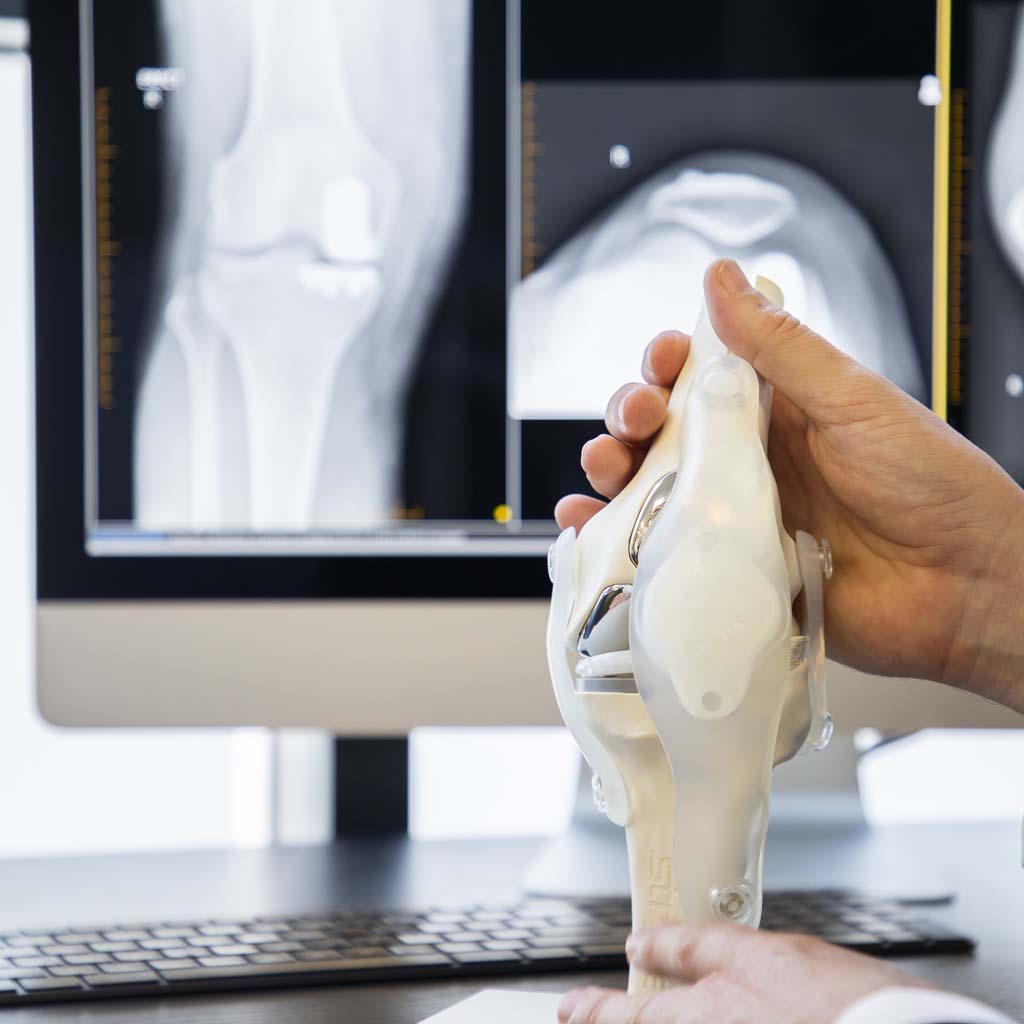
The MRI confirmed a complete ACL rupture with bruising to the surrounding bone and no damage to the other major stabilising structures. ACL reconstruction was recommended by orthopaedic knee surgeon Dr Jonathan Negus, using a hamstring graft and a second procedure to add rotational stability. Surgery went ahead in early August.
Targets for rehabilitation
Four qualities had to improve before any sport could be reintroduced, each with its own testing checkpoint.
Quadriceps strength. Strength on the surgical side underpins how the knee absorbs load on landing and deceleration, and rebuilding it is the first target of a structured rehabilitation program.
Hamstring recovery after graft harvest. The graft was taken from his own hamstring, so the muscle group asked to protect the knee was also recovering from the harvest. Hamstring measures were expected to lag and were tracked separately, not folded into a general strength score.
Power and force absorption. Skiing, surfing and tennis all require force produced quickly and absorbed under control. Strength alone does not build that, so power was trained and tested in its own right.
Sport-by-sport clearance. Clearance could not be a single decision. Each activity was reintroduced on its own merits.
The rehabilitation plan
Care followed a staged program built around him, with each phase resting on what the one before it had established.
Early recovery
Early recovery focused on restoring full range of motion, settling swelling and re-establishing a normal walking pattern.
At around six weeks, care moved to a structured exercise physiology program built around the recognised phases of ACL rehabilitation, progressing from foundational strength and movement quality to the heavier loading and power work required before running and sport.
Objective testing at every stage
A knee usually feels capable before the testing agrees, so progression was criteria-based rather than calendar-based, as it is across most ACL recovery timelines. Strength, jump mechanics and side-to-side symmetry were retested at intervals, and the results decided whether the program advanced or held.
Shared oversight with the surgeon
Surgical and rehabilitation decisions were not made separately. Dr Negus reviewed progress at 12 weeks, confirming the knee was stable and tracking well, and again before the final return-to-sport stages ahead of a planned ski trip. With the clinical and the functional picture visible at the same time, every call to push load or pull it back rested on more than one perspective.
How the nine months progressed
Stage
Timing
What happened
Pre-operative testing
Before surgery
Baseline strength, mobility and symmetry testing; hip strength more than 30% lower and knee strength around 26% lower on the injured side
Surgery
Early August
Hamstring graft ACL reconstruction with a second procedure for rotational stability
Early recovery
First six weeks
Restoring full range of motion, settling swelling and re-establishing a normal walking pattern
Structured rehabilitation begins
From around six weeks
Exercise physiology-led program through the recognised phases of ACL rehabilitation
Surgeon review
12 weeks
Knee confirmed stable and tracking well
Plateau
Around four months
Two strength and power measures short of benchmark, plus irritation around the graft site tendon; running held back
Return to running
January
Retesting cleared the missing measures and a full return-to-run session followed
Performance phase
Months 6–9
Power, plyometric, jump and landing work, with sports reintroduced in sequence
Discharge
Nine months
Final testing block completed and handover to independent strength maintenance
Progress, setback and return
The next stretch of rehabilitation did not run in a straight line.
Steady progress through the middle phase
He committed to the process from the outset and kept up the work between appointments. Compliance was never a limiting factor through the middle phase.
Setback at four months
At roughly four months post-operative, two strength and power measures fell short of the benchmarks required to progress, and irritation developed around the graft site tendon. Months of steady work sat behind him and he was keen to start running. He felt ready. The testing said not yet.
Plateaus are an ordinary feature of ACL rehabilitation. Instead of pushing through, the program changed shape. Power and plyometric work became more specific, a short loading block was added to settle the tendon, and time went into explaining why the delay was a normal part of the process. Retesting early in the new year showed the missing pieces had arrived, and a full return-to-run session followed in January.
Shift from rehab to performance
Clearing running opened the next problem instead of closing one. Each of his three remaining sports asks for a different quality again. Force produced quickly, and force absorbed under control through the leg, matters more here than the repeatable strength that carries someone through a run.
From months six to nine the sessions looked more like performance training than rehabilitation, with jump and landing mechanics tracked to confirm the knee could manage load and speed together without earlier strength gains slipping. That shift in tone mattered, keeping him engaged and disciplined through a long stretch of the process.
Return to each sport
Sports were reintroduced in sequence. Longer blocks of surfing and running came first, then recreational tennis, with skiing held back until conditioning supported it.
The testing results
All figures below come from his final testing blocks.
Quadriceps strength
A side-to-side deficit of around 26% before surgery closed to 1.6%, at 802 newtons (N) on the uninjured side and 789 N on the surgical side, effectively symmetrical. Both legs sat in the 99th percentile.
Knee extension (quadriceps) strength, tracked left against right through to final testing.
Hamstring strength
From a deficit of around 25%, and with the fluctuation expected while a graft site adapts, hamstring strength settled at a 14% deficit, at 483 N on the uninjured side and 417 N on the surgical side. Both sides also improved in absolute terms, by 15% and 17%.
Knee flexion (hamstring) strength, tracked left against right through to final testing.
Asymmetry moved from 39% before surgery to a low of 9.8% through the power phase, settling around 18% at final testing. This was among the slower measures to stabilise, consistent with hamstring graft healing.
Jump velocity
This measure captures how fast, and how willingly, he could take load and slow it down through the knee. It improved from -1.34 metres per second (m/s) at the start of the power phase to -1.49 m/s at the final testing block shown below, in the 98th percentile. It was among the clearest indications that he had begun to trust the leg at speed.
Eccentric peak velocity during the countermovement jump, improving through the power phase.
Tested one leg at a time, the two sides came back close to even at -0.93 m/s and -0.96 m/s, a difference of 3.6%. Deceleration control had returned on the surgical side specifically, not only when both legs shared the work.
Single leg jump eccentric peak velocity, with the surgical side tested on its own.
Jump height
Two-leg jump height reached 36.8 cm at final testing, a 5.3% improvement, reflecting lower body power returning across both legs.
Countermovement jump height, tracked across the full power phase.
Single leg jump height on the surgical side rose from 9.8 cm at the start of the power phase to 11.3 cm by later testing, against 15.0 cm on the uninjured side, a 25% difference. Strong overall progress can still sit alongside a measurable gap.
Single leg jump height, tracked left against right, showing the remaining gap between the surgical and uninjured leg.
Nine months to discharge
Discharge followed roughly 30 supervised sessions and a good deal of independent work. By then he was surfing, running, skiing and playing tennis again, equipped for what each of them asks of a knee.
Before and after
Measure
Earlier in the process
At final testing
Quadriceps side-to-side deficit
Around 26% before surgery
1.6% (802 N uninjured, 789 N surgical)
Hamstring side-to-side deficit
Around 25%
14% (483 N uninjured, 417 N surgical)
Hamstring asymmetry
39% before surgery
Around 18%, after a low of 9.8% through the power phase
Countermovement jump eccentric peak velocity
-1.34 m/s at the start of the power phase
-1.49 m/s, 98th percentile
Single leg jump height, surgical side
9.8 cm at the start of the power phase
11.3 cm, against 15.0 cm on the uninjured side
Body weight
102 kg
82 kg, maintained since
Alongside rehabilitation, he moved from 102 kg to 82 kg during his recovery and has maintained it since.
Strength maintenance after discharge
He now handles his own program, using the structure and the testing knowledge built through rehabilitation.
A 25% difference between sides at discharge is not a closed number. He now has the tools and the understanding to keep narrowing it.
The surgeon
Dr Jonathan Negus
Orthopaedic Surgeon – Hip & Knee · FRACS (Orth)
Dr Negus performed the ACL reconstruction in this case and reviewed progress at 12 weeks and again before the final return-to-sport stages. He works alongside MTP Health's physiotherapy and exercise physiology team so surgery and rehabilitation are managed as one plan.
View full profile →
Trust comes back in stages
The uncertainty is usually the hardest part of an ACL reconstruction, whether you are facing surgery or already partway through rehabilitation. Seeing your own numbers move, and knowing what still has to shift before the next stage, takes most of that weight off and puts you back in charge of your own recovery.
At MTP Health, orthopaedic surgeons, physiotherapists and exercise physiologists work from the same testing data, so you know where your knee stands at each stage, and an assessment at our St Leonards or Beacon Hill clinic is where that starts. If you are not sure where to begin, your GP can point you in the right direction.
Confidence in a knee is rebuilt the same way strength is, one measurable step at a time. Getting back to the things you love is a fair thing to want, and a plan built around you will tell you how close you are.
Where to find us
ACL rehabilitation across Sydney
St LeonardsNorth Shore Health Hub, Level 4, Suite 401, 7 Westbourne St, St Leonards NSW 2065
St Leonards clinic →
Beacon Hill173 Warringah Road, Beacon Hill NSW 2100 — serving the Northern Beaches
Beacon Hill clinic →
Case study de-identified · Surgery performed by Dr Jonathan Negus, Orthopaedic Surgeon · Rehabilitation delivered through the ACL Rehab Program
Pre-operative, interim and final strength, jump and symmetry testing completed at MTP Health.
Recognised phases of ACL rehabilitation and criteria-based return-to-sport progression.
This case study has been de-identified. It describes one person's rehabilitation and is provided as general information about our approach to ACL rehabilitation. It is not clinical advice and outcomes differ between individuals depending on the injury, the surgery, other health factors and the rehabilitation completed. Anyone with a knee injury should seek an individual assessment.