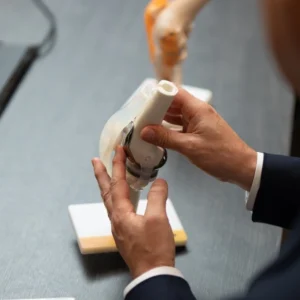
Pain on the outside of the knee is a common reason people book an assessment with us at MTP Health. Most online advice assumes this outside knee pain is iliotibial band syndrome and that you are a runner. If you are over 40 and lateral knee pain has crept in without a clear injury, that explanation often does not fit.
Key Takeaways
- Outer knee pain comes from the lateral meniscus, lateral compartment cartilage, lateral collateral ligament, iliotibial band or biceps femoris tendon, all part of the knee joint.
- Under 40 the cause is usually a tendon or ligament. Over 40 a degenerative lateral meniscus tear or early lateral compartment osteoarthritis becomes more likely.
- A knock-knee (valgus) alignment loads the outer compartment and can drive wear on that side.
- Joint-line pain that worsens with deep bending or twisting and keeps building deserves a proper assessment.
- Most outer knee pain improves with a structured physiotherapy and strength program. Arthroscopy or a distal femoral osteotomy are options for a specific group.

Where Outer Knee Pain Comes From
On the outer side of the leg, where the thigh bone meets the shin bone, sits the lateral meniscus, a crescent of cartilage that spreads load, over bone surfaces covered in smooth articular cartilage. The lateral collateral ligament runs down the outside and resists the knee bowing outward.
The iliotibial band, a thick band of connective tissue that runs down the outer thigh from the hip, attaches just below the joint, and the biceps femoris tendon anchors to the top of the fibula. Each of these structures, some muscle and tendon, some fibrous tissue, hurts in a slightly different way, and the right plan for a tendon is not the right plan for a worn joint.
Common Causes Under 40
In younger, active people, outer knee pain is most often a load problem in soft tissue. Iliotibial band syndrome, also called iliotibial band friction syndrome or runner’s knee, produces a sharp ache on the bony point at the outside of the knee that builds during running and settles with rest. It is typically an overuse injury that follows a sudden increase in distance or hills rather than a single event.
A lateral collateral ligament sprain is more of a structural injury, following a force that pushes the knee outward, sometimes in sport or a car accident, and leaves the knee feeling less steady on uneven ground. Biceps femoris tendinopathy makes the back-outer corner feel sharp with hard acceleration.
These band syndrome and tendon problems generally respond well to a graded loading program with the physiotherapy team at our orthopaedic and physiotherapy clinic on Sydney’s North Shore, and most people can still bear weight and load the other leg normally while they settle. Clinical reviews of iliotibial band syndrome (Tapscott DC) describe the same pattern.
Common Causes Over 40
From the mid-40s on, the lateral meniscus loses some of its resilience and a degenerative meniscus tear can develop through everyday loading rather than a single twist. The pain sits on the joint line, is often worse squatting, kneeling, climbing stairs or getting out of a low chair, and can ache at night. This lateral meniscus irritation can also cause referred pain that spreads a short way up or down the leg.
The other change is wear of the cartilage in the lateral compartment, a form of knee arthritis. Arthritis on the inner side of the knee is more common and is covered in our article on inner knee pain. Lateral compartment osteoarthritis tends to appear in knees with a knock-knee alignment and can be painful even when an X-ray shows only modest change, and for some people it becomes chronic knee pain where the pain worsens over months.
That alignment matters. When the leg is valgus, body weight passes through the outer half of the knee, so the lateral compartment does more than its share of the work with every step. Over the years that extra load can wear the cartilage and meniscus on that side while the inner side stays healthy, and recognising it early opens up ways to protect that compartment.
Signs Outer Knee Pain Matters
Plenty of outer knee pain settles within a few weeks of sensible load management, in line with Australian knee pain guidance. Tenderness on the joint line itself points toward the meniscus or cartilage, and pain reproduced by a deep bend combined with a twist is another meniscus signal.
An ache building month on month in a knee that has always sat knock-kneed suggests the compartment is under strain, and a knee that will not hold on slopes after a knee injury can mean the lateral ligament has been stretched. Severe pain, a knee that cannot bear weight, and a knee that catches or locks are covered in separate articles, but either alongside outer joint-line pain is a reason not to wait.
How MTP Health Assesses It
Assessment starts with your story: when the pain started, what brings it on, and what you want to get back to. A physical exam then looks at how you stand and walk, from the hip down to the foot, because alignment is visible before it shows on any scan, and uses hands-on tests to separate the structures and reach the right diagnosis.
Dr Jonathan Negus assesses the structural side, including whether a lateral meniscus tear or compartment wear is likely and how your alignment is contributing.
The MTP physiotherapy and exercise physiology team assesses strength, hip strength, weakness in the supporting muscles and movement patterns, which is often where the fixable causes live. This combined diagnosis is more reliable than any single test, and your doctor uses it to decide what, if anything, needs imaging.
Imaging is used when it will change the plan. A standing alignment X-ray shows how load is distributed across the knee and is the key test if valgus is suspected, and an MRI can confirm a lateral meniscus tear or early cartilage change.
Treatment Options And Surgery
For most people the first step is a structured treatment plan with the MTP physiotherapy and exercise physiology team, led by a physical therapist: adjusting the activities that flare the knee without stopping altogether, building strength through the hips, quadriceps and hamstrings, and improving how your leg lines up under load.
In the early, irritable phase, simple steps such as a bag of frozen peas wrapped in a towel can reduce inflammation and settle a flare, and a gradual return to running or sport protects the damaged tissue while it adapts. Many degenerative lateral meniscus tears and early compartment changes settle well over eight to twelve weeks.
Surgery is one part of the picture for a smaller group. A knee arthroscopy may be considered when a lateral meniscus tear keeps producing symptoms despite good rehabilitation, so the torn portion can be trimmed or repaired. For a person with a valgus knee and wear confined to the lateral compartment, a distal femoral osteotomy realigns the thigh bone so that body weight shifts toward the healthier inner side.
It is a joint-preserving operation for people who are too young or too active for a knee replacement, with a period on crutches and a planned return to load over several months.

Like any operation, these procedures carry risks, including infection, blood clots, stiffness and the possibility that pain does not settle as hoped. Dr Negus discusses the likely benefits alongside those risks once non-surgical options have had a fair trial, so surgery is only chosen when it is the right way to treat the problem. Where surgery is chosen, the MTP team prepares you with prehab and guides the rehabilitation afterwards, so the operation is one stage in a longer plan.
Frequently Asked Questions (FAQs)
Why does the outside of my knee hurt when I walk?
Walking loads the lateral compartment with every step, so pain with walking often involves the lateral meniscus, the cartilage on that side, or a knock-knee alignment that concentrates load there. In younger people it may be iliotibial band irritation instead.
Is pain on the outside of the knee a sign of arthritis?
It can be, particularly after 45 and in a knee that has always sat slightly knock-kneed. Lateral compartment osteoarthritis is less common than inner-side arthritis but tends to be painful for its stage, and other causes are possible, so a persistent ache is worth checking.
Can a lateral meniscus tear heal without surgery?
Degenerative tears in adults have limited capacity to heal, but they often become pain-free with a strength and load program even though the tear remains. Surgery is generally reserved for tears that keep causing symptoms despite rehabilitation.
What is a distal femoral osteotomy?
It is an operation that cuts and realigns the lower thigh bone so that body weight shifts away from a worn outer compartment toward the healthier inner side. It suits people with a valgus knee and wear limited to the lateral side, and recovery takes several months.
When should I see a specialist about outer knee pain?
Book an assessment if the pain sits on the joint line, is brought on by deep bending or twisting, has been building for more than a few weeks, or follows an injury that left the knee unsteady. A knock-knee alignment with new outer knee pain is another reason to be seen early.
Conclusion
Outer knee pain is not one condition. In younger people it is usually a tendon or ligament responding to load; after 40 it is more often the lateral meniscus, the lateral compartment cartilage, or the alignment of the leg driving both.
These are among the most common causes, and most people improve with a well-planned physiotherapy and strength program, while for a specific group surgery can help protect the joint. If the outside of your knee has been bothering you, book an assessment with MTP Health on (02) 9437 9794 and we will plan the way forward together.
Recent Post
-
Multiple Joint Pain: Causes and What It Can Mean
Key Takeaways Pain in several joints at once usually points to a form of arthritis,…
-
Serious Joint Pain: Red Flags and When to See a Doctor
Key Takeaways A hot, swollen joint with a fever can be a sign of a…
-
Knee Pain Going Down Stairs and Downhill: What It Means
Key Takeaways Going down stairs or slopes loads the kneecap joint more than level walking,…
-
My Knee Is Swollen and Sore: When Should I Worry?
Key Takeaways A knee that is hot and swollen with a fever, or one leg…
-
Inner Knee Pain and Why the Side of Your Knee Hurts
Key Takeaways The side your knee hurts on shortlists the cause, because the inner and…
-
Tennis Elbow vs Golfer’s Elbow: Which One Do You Have?
Key Takeaways Tennis elbow causes pain on the outer side of the elbow and golfer’s…
-
Dislocated Shoulder: When Does It Need Surgery?
Key Takeaways Surgery is usually considered when a shoulder keeps dislocating, when scans show bone…
-
Movement Is the Medicine for Arthritis, Not Rest
Key Takeaways Movement is first-line care for knee and hip osteoarthritis, while rest tends to…
-
How to Delay a Knee or Hip Replacement: The Joint-Preservation Window
Key Takeaways The joint-preservation window is the period when a knee or hip has enough…
-
How to Increase Bone Density: Why Bones Need Load, Not Just Calcium
Key Takeaways Calcium is the material bone is built from, not the signal that builds…