

CrossFit has redefined, or should I say defined, what it means to be ‘fit’. It has taken the ambiguity and subjectivity out of the debate about who or what sport has the fittest athletes on earth and created an arena for people to actually measure their fitness against their peers. It is true that there are elements to CrossFit that CrossFit athletes need to be able to do in order to be competitive (insert: butterfly kipping pull-up, muscle ups, hand stand push ups), which are not necessarily skills that athletes from all other sports will know. However, they are all elements that are prevalent in some sports (Gymnastics) and are therefore relevant components to any test of fitness. The same can be said for the Olympic lifts that are included in CrossFit competitions. Your average triathlete (although very aerobically fit) won’t necessarily know how to complete a snatch or clean and jerk. These elements, however, are relevant in a well-rounded test of fitness. On the other hand, the Olympic lifts are the ultimate test of power and mobility, but they don’t test for aerobic capacity (endurance). Therefore the combined test of fitness developed by CrossFit is an incredibly well balanced and well-rounded analysis of fitness.
The weekend’s competition in Wollongong saw an amazing gathering of fit, healthy, strong people ready to test their ability against their peers. Every single competitor would, in every sense of the word, be considered ‘fit’ by the average person (success for the CrossFit model).
A feature of this year’s competition was the apparent strength/power emphasis; everything seemed to be heavy. So it seemed that everything would be easier if you were a bigger, stronger athlete. To a certain degree, the competition reflected this; there were an abundance of big strong men and women murdering the weight presented to them. However, the most beautiful thing to see was how the best athletes of the weekend were not only strong and powerful with great endurance, they also displayed the best movement quality.
What do I mean by this? The athletes that performed the best over the course of the weekend had the most efficient movement and were able to express their strength and power better than other athletes who may have been ‘stronger’ in the raw sense of the word.
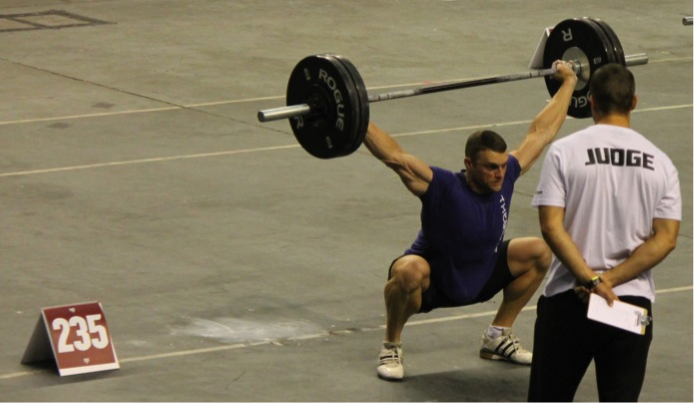
The two best examples of this were Kara Gordon in event 2, setting the fastest time in the world for the 2km row + 50 pistol squats + 30 Hang Cleans (60kg). And Chad Mackay in the snatch ladder hitting a 265lb (120kg) snatch.
Kara Gordon not only displayed amazing efficiency and power on her hang cleans, but also showed sublime stability, range of motion and control to power through 50 pistol squats with a smile and a wave to her fans mid squat. While Chad Mackay’s snatch ladder, which included 240 double under’s (skips with 2 rope revolutions for every jump) and 2,520lbs worth of completed snatches in the 13 minutes, was an amazing display of movement efficiency and control.
While there were bigger men in the field who listed bigger PR deadlifts and squats, once the weight reached 225lbs (or 100kg) the number of athletes completing lifts plummeted. The technique displayed by the athletes varied from horrible to incredible, and the man with the best technique was the last man standing. Chad did what no other athlete chose to do: lift with the same technique and tempo from the first lift to last lift, reinforcing the good movement patterns he had practiced over and over again leading up to the competition.


|
Event 2: 2km row, 50 pistol squats and 30 hang cleans (102kg)
|
Surely your hang clean will fall apart by the end of this.
|
Maybe not!
|


Recent Post
-
Why Do Your Joints Ache in Menopause, and What Helps?
Key Takeaways Falling and fluctuating oestrogen around perimenopause and menopause can leave joints stiff and…
-
Inflammatory Joint Pain: Psoriatic Arthritis and Other Causes
Key Takeaways Inflammatory joint pain is usually stiffest after rest, eases with movement and affects…
-
How Much Does Shoulder Surgery Cost in Australia?
Key Takeaways Public care as a public patient carries no direct cost for the surgery,…
-
Cortisone Injection for Shoulder Pain: Does It Actually Work?
Key Takeaways A cortisone injection settles inflammation and eases pain for a period, but it…
-
Shoulder Pain at Night: Why It Worsens and When to Act
Key Takeaways Lying down loads the shoulder differently and removes the daytime movement that masks…
-
Wrist Pain on the Little Finger Side: TFCC Injuries
Wrist pain on the little-finger side is often a TFCC injury. Learn the signs, why it clicks on rotation, physio-first care and when arthroscopy helps.
-
Wrist Pain After a Fall on an Outstretched Hand
Sore wrist after a fall on an outstretched hand? How to tell a scaphoid fracture, ligament sprain and distal radius fracture apart, and what to do next.
-
Stiff Elbow After a Fracture: Why It Won’t Straighten
Elbow still won’t straighten after a fracture? Why post-fracture stiffness happens, how the rehab window works and when arthroscopic release is considered.
-
A Pop at the Elbow When Lifting: Distal Biceps Rupture
A sudden pop at the elbow when lifting may be a distal biceps rupture. Learn the signs, why the first weeks matter, and repair versus rehab options.
-
Numb Ring and Little Finger: Cubital Tunnel Syndrome
Numb ring and little finger, worse with a bent elbow or at night? Learn the signs of cubital tunnel syndrome and how MTP Health treats it.


Well said Luke was inspirational to witness ordinary people doing extraordinary things! Your good self included. Can’t wait for next year.
Hey Luke, “textbook” as always. You should submit to “wodtalk” magazine. they need commentary of that calibre.