
Revision Knee Replacement in Sydney
When a knee replacement becomes painful, loose, unstable, infected or worn, revision surgery may be needed to replace part or all of the implant. These are complex procedures, so the first step is careful assessment, clear planning and a rehabilitation pathway built around your knee.
What is revision knee replacement?
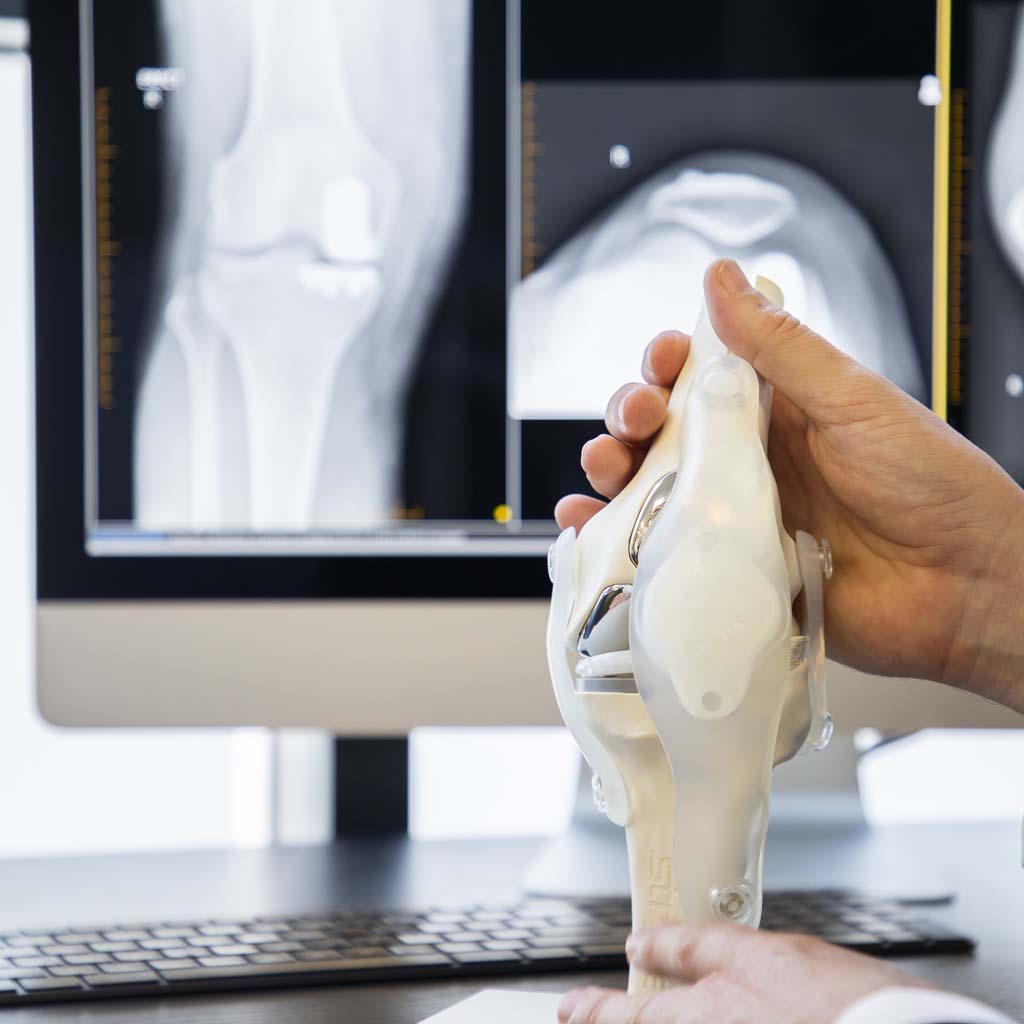
A revision knee replacement is surgery to remove and replace part or all of a previous knee replacement. It may be needed when an implant has worn out, loosened, become infected, become unstable, fractured nearby bone or is no longer relieving pain and function as expected.
Revision surgery is usually more complex than a first-time total knee replacement. The old implant may need to be removed, bone defects may need to be rebuilt, and specialised revision components may be used to improve fixation, alignment and stability.
Sometimes only one component needs replacing. In other cases, the femoral, tibial and patellar components need to be removed and replaced. If infection is present, treatment may involve more than one operation and a longer recovery pathway.

Do you need revision knee replacement?
You may need assessment for revision knee replacement if you have ongoing or worsening pain after a knee replacement, swelling, instability, stiffness, reduced walking ability, changes in alignment, warmth around the joint, or a sense that the knee is not working as it should.
Common reasons for revision include aseptic loosening, polyethylene wear, infection, instability, stiffness, fracture around the implant, patella problems, progression of arthritis after a partial knee replacement, or persistent pain that has not resolved after the original operation.
A painful knee replacement does not always mean revision surgery. Some symptoms come from soft tissue irritation, weakness, referred pain, scar sensitivity or rehabilitation issues. Your assessment should look for the cause before deciding whether surgery is the right next step.
Your assessment may include X-rays, blood tests such as ESR and CRP to look for infection, CT scans, bone scans, MRI in selected cases, and sometimes knee aspiration where fluid is removed from the joint and tested. The goal is to understand the problem before planning the operation.
Benefits and risks
What you can expect it to achieve
- Reduce pain from a loose, worn, infected or unstable knee replacement
- Improve walking ability, alignment and confidence
- Replace worn or damaged implant components
- Rebuild bone defects where possible
- Treat infection when present as part of a staged plan
- Improve stability using specialised revision implants where needed
- Support return to daily activities with structured rehabilitation
Risks to understand
- Common and temporary: swelling, bruising, stiffness, pain and reduced energy during early recovery
- General risks: infection, blood clots, bleeding, anaesthetic complications, urinary difficulty, chest infection, heart complications and stroke
- Revision-specific risks: fracture during implant removal or insertion, ligament or tendon injury, nerve or blood vessel injury, instability, stiffness and ongoing pain
- Implant-related risks: loosening, wear, dislocation, infection recurrence or need for further revision in future
- Recovery risk: revision surgery usually takes longer to recover from than a first knee replacement
All surgery carries risk and outcomes vary between individuals. Dr Jonathan Negus will discuss how these risks apply to you. Revision knee replacement can be very helpful, but it is a major operation and the result depends on the reason for failure, bone quality, infection status, your health and your rehabilitation.
Why knee replacements fail
Most knee replacements last many years, but no implant lasts forever. Over time, the plastic liner can wear, implants can loosen from the bone, or the knee can become unstable or painful.
Infection is one of the most important causes to rule out because it changes the entire treatment plan. A revision for infection may need staged surgery, antibiotics and a longer recovery than revision for simple wear or loosening.

| Reason for revision | What it may mean |
|---|---|
| Loosening | The implant has lost firm fixation to the bone and may cause pain or instability |
| Polyethylene wear | The plastic liner has worn, which can cause debris, swelling, osteolysis or loosening |
| Infection | Bacteria around the implant may require antibiotics and sometimes staged revision surgery |
| Instability | The knee may feel loose, give way or move abnormally because of ligament or implant problems |
| Fracture | A break around the implant may require fixation, revision components or both |
| Stiffness or pain | The cause needs careful investigation before revision is considered |
The procedure: what happens
Before surgery, you will have a detailed work-up to understand why the knee replacement is failing. This may include X-rays, blood tests, infection screening, aspiration, CT or other imaging. You may also see a physician and anaesthetist to optimise your health before surgery.
Revision knee replacement is usually performed under general or spinal anaesthesia. Your surgeon usually uses the previous incision where safe. If there are multiple scars, the safest incision is selected to protect skin and soft tissue healing.
Fluid and tissue samples may be taken from the knee during surgery, especially if infection is possible. The failed or worn implant components are then carefully removed. Any cement, loose tissue or damaged bone is managed, and bone defects may be rebuilt with graft, cement, metal augments, cones, sleeves or specialised revision components.
New revision implants are inserted to restore alignment, fixation and stability. These implants may have stems that extend into the bone canals for extra support, and some revision knees use more constrained designs if the ligaments cannot provide enough stability.
Before closing, the knee is checked for stability, alignment, motion and tracking. A drain may be used in selected cases. The wound is closed, dressed and protected, and an X-ray is usually taken after surgery to confirm implant position.
After surgery
You will wake in recovery, where your pain, circulation and vital signs are monitored. You will then return to the ward and begin a supervised recovery. Antibiotics, blood-thinning medication, compression devices and stockings may be used depending on your risk profile and surgical plan.
Your hospital stay depends on the complexity of surgery, pain control, mobility, wound healing and home support. Some people go directly home once safe, while others may need inpatient rehabilitation or additional support.
When to seek help. Contact us or seek urgent care if you develop fever, increasing calf pain or swelling, chest pain, shortness of breath, spreading redness, wound discharge, worsening pain, new instability or sudden loss of movement. Concerned about your recovery? Call (02) 9437 9794.
Revision knee replacement recovery and rehabilitation
Post-operative rehabilitation after revision knee replacement is usually slower than after a first knee replacement. This is because the operation is more complex, the soft tissues have already been through surgery, and there may be bone loss, infection, stiffness or instability to manage.
The early goals are pain control, wound healing, safe walking, swelling management and restoring knee movement. Longer-term rehabilitation focuses on strength, balance, endurance, confidence and getting back to safe everyday activities.
Recovery timeline
| Phase | Timeframe | What to expect |
|---|---|---|
| Hospital recovery | Days 0–5+ | Pain control, wound monitoring, X-ray, blood clot prevention and supervised walking |
| Protect & settle | Weeks 0–6 | Walking aids, swelling control, home exercises, wound care and gradual mobility |
| Movement & strength | Weeks 6–12 | Improving range of motion, walking distance, balance and basic strength |
| Functional recovery | Months 3–6 | Progressive strengthening, stairs, longer walks and return to many daily activities |
| Longer-term improvement | Months 6–12+ | Ongoing gains in comfort, stamina and confidence; complex revisions may take longer |
Timeframes are a guide. Your surgeon and rehabilitation team will progress you based on the reason for revision, implant stability, bone quality, wound healing and your overall health.
Post-operative care
At home, the priorities are wound care, swelling control, medication safety, blood clot prevention, walking regularly and completing your prescribed exercises. Keep the wound clean and dry as instructed and attend all follow-up appointments.
Revision surgery can involve a higher risk of infection and wound issues than a first knee replacement. Increasing redness, discharge, fever, worsening swelling, calf pain or shortness of breath should be checked urgently.
Rehabilitation at MTP Health
This is where MTP Health is different. Your rehabilitation is delivered by our physiotherapists and exercise physiologists in the same clinic as your surgeon, so your plan can be adjusted based on the complexity of your revision and your progress.
Pre-operative rehabilitation before surgery can help improve strength, walking confidence and readiness. After surgery, rehabilitation focuses on safe mobility first, then gradually rebuilding movement, strength, balance and independence.
Because revision cases vary widely, your plan may look different from someone else's. A revision for infection, fracture, bone loss or severe stiffness may need a more cautious progression than a straightforward liner exchange.
Returning to driving, work and activity
Driving depends on which knee was operated on, your pain, medication use, walking ability and whether you can safely perform an emergency stop. You must be off strong pain medication and should check with your surgeon and insurer before driving.
Return to work depends on your role and the complexity of your surgery. Desk-based work may be possible once pain, swelling, transport and fatigue are manageable. Heavy manual work may not be advisable or may require a much longer recovery period.
The aim is usually to return to low-impact activities such as walking, swimming, cycling and golf. Higher-impact activity, running, jumping or heavy repetitive loading may not be recommended after revision knee replacement.
Revision surgery starts with diagnosis. The best plan depends on finding out why the first knee replacement is failing. Pain alone is not enough information — infection, loosening, instability, stiffness and referred pain all need to be considered.
Revision knee replacement cost in Sydney
The cost of revision knee replacement depends on your private health cover, hospital insurance, surgeon fees, anaesthetist fees, assistant fees, implant costs, hospital stay, investigations and whether infection treatment or complex reconstruction is required.
Revision surgery is usually more complex than primary knee replacement, so the cost can vary more widely. You will receive a written quote before surgery once the likely procedure, implants and hospital pathway are known. For a broader overview of related fees, see our knee and hip replacement cost guide.
The anaesthetist is an independent practitioner and may charge a separate gap. We provide their details and recommend checking their quote before committing to surgery. Your insurer may also have an excess to pay, commonly around $500 depending on your policy.
If revision surgery is performed through the public system, there is no out-of-pocket surgical cost, but waiting times and timing depend on urgency, infection status, hospital resources and clinical priority.
Why have your revision knee replacement at MTP Health
MTP Health brings together knee surgery specialists, physiotherapists and exercise physiologists in one clinic. That matters because revision knee replacement is not a one-size-fits-all operation. The cause of failure needs to be understood before a safe plan can be made.
Honest advice comes first. If surgery is not the right next step, we will explain why. If revision is needed, we will walk you through the investigations, procedure, risks and recovery so you understand what is realistic for your knee.
Your surgeon

Dr Jonathan Negus
Dr Negus is a fellowship-trained hip and knee surgeon who works alongside MTP Health's physiotherapy and exercise physiology team so your surgery and rehabilitation are managed as one plan.
View full profile →Frequently asked questions
How long does a revision knee replacement take?
A revision usually takes longer than a first-time knee replacement because the old implant needs to be removed and, in some cases, bone or soft tissue needs to be rebuilt.
On average, the procedure may take around two to four hours, although timing varies significantly depending on the complexity of the case.
Your surgeon can give you a clearer estimate once your assessment, imaging and surgical plan are complete.
How soon after a first knee replacement might I need a revision?
Most knee replacements last many years, so revision is often not needed for a long time, if at all.
Occasionally, problems such as infection, loosening, instability, stiffness, fracture or other complications can appear earlier.
If you develop pain, swelling, warmth, instability or changes in movement after a knee replacement, assessment with a knee specialist is recommended.
Will revision surgery limit my activities?
The aim of revision surgery is generally to reduce pain and improve mobility.
Many people are able to return to low-impact activities such as walking, swimming, cycling and golf.
Higher-impact sports, running, jumping or heavy manual work may not be advised, especially if bone quality, implant stability or soft tissue support is a concern. Your surgeon can discuss activity guidelines suited to your situation.
Can physiotherapy help before and after revision surgery?
Yes. Preparing beforehand through prehabilitation, and following a structured rehabilitation program afterwards, can both play an important part in recovery.
Our physiotherapists and exercise physiologists tailor these programs to your needs, although individual progress can vary.
The aim is to support improvements in movement, strength, walking ability and confidence over time.
Who should I see if I am worried about my knee replacement?
If you are experiencing knee pain, swelling, warmth, instability or changes in movement after a knee replacement, a good first step is to speak with your GP.
Your GP can refer you to an orthopaedic surgeon for further assessment if needed.
Our team can also support you with assessment, education and rehabilitation as part of working through your options.
What are the most common reasons for revision knee replacement?
Common reasons include loosening, infection, instability, polyethylene wear, stiffness, fracture around the implant and ongoing pain that has not settled after the first operation.
Part of the assessment is identifying which of these is most likely so the treatment plan can address the real cause.
Is revision knee replacement harder to recover from than the first surgery?
Often, yes. Revision knee replacement is usually more complex than a first knee replacement, and recovery can take longer.
This is especially true if there has been infection, bone loss, stiffness, instability or previous surgery around the knee.
Can infection cause a knee replacement to fail?
Yes. Infection around a knee replacement can cause pain, swelling, loosening and implant failure.
If infection is suspected, your surgeon may arrange blood tests, aspiration and specialised imaging. Treatment may involve antibiotics, washout surgery or staged revision depending on the situation.
Revision knee replacement consultations across Sydney
North Shore Health Hub, Level 4, Suite 401, 7 Westbourne St, St Leonards NSW 2065
St Leonards consulting →173 Warringah Road, Beacon Hill NSW 2100 — serving the Northern Beaches
Beacon Hill consulting →Also consulting at Gosford, Wahroonga, Castle Towers and Tamworth.
Talk to a surgeon about your knee replacement
Book a consultation to find out why your knee replacement is painful, loose or unstable — and whether revision surgery is the right next step.
Book a ConsultationPrefer to talk? Call (02) 9437 9794 · GP & physio referrals: referrer information
- American Academy of Orthopaedic Surgeons, Revision Total Knee Replacement patient guidance.
- Healthdirect Australia, Revision total knee replacement patient guidance, last reviewed January 2026.
- Australian Orthopaedic Association National Joint Replacement Registry, 2025 Annual Report and revision data.