
Patellofemoral Joint Replacement in Sydney
When arthritis is limited to the joint under the kneecap, a patellofemoral replacement can resurface only that compartment while preserving the healthy parts of the knee. Your surgery, recovery and rehabilitation are planned together at MTP Health.
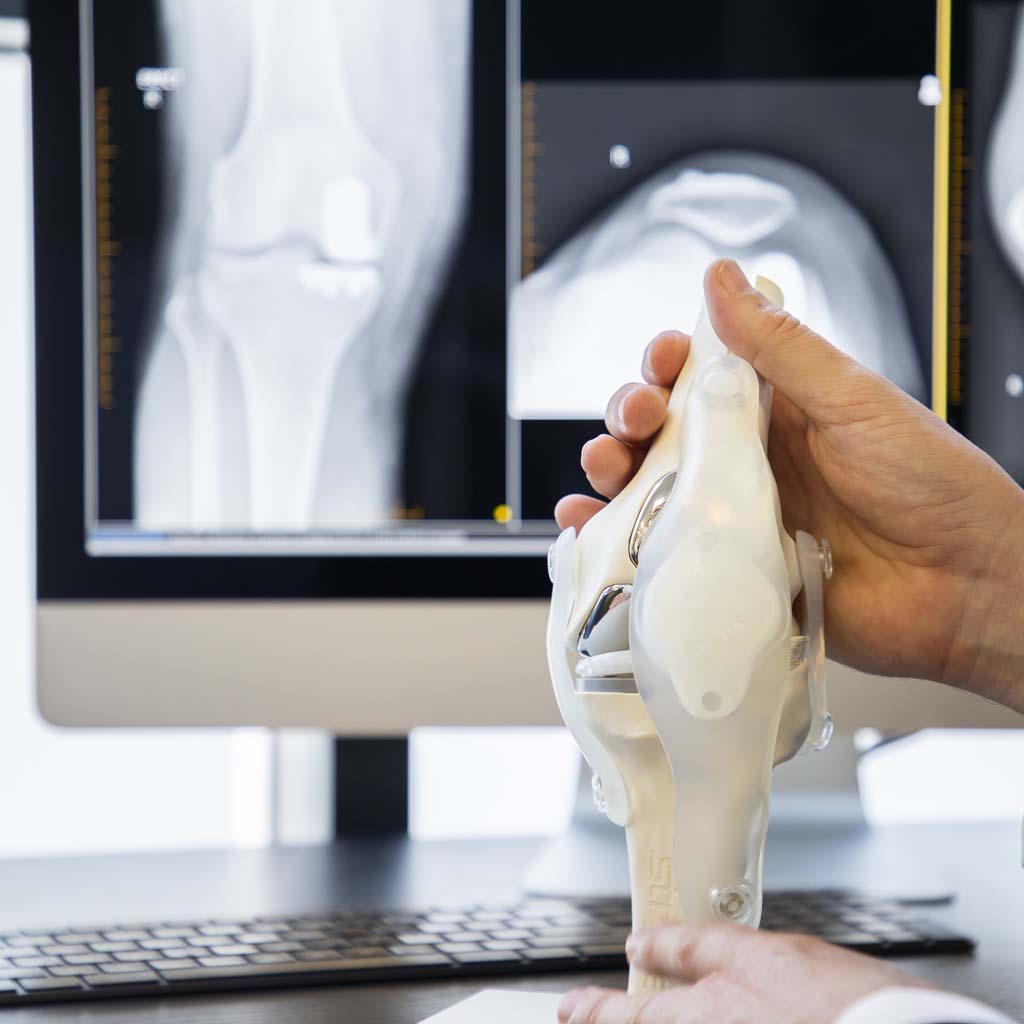
What is a patellofemoral joint replacement?
A patellofemoral joint replacement, also called a patella joint replacement or kneecap joint replacement, is a type of partial knee replacement. It replaces only the arthritic joint surfaces between the kneecap, or patella, and the groove at the front of the thigh bone, called the trochlea.
The knee has three main compartments: the medial compartment on the inside, the lateral compartment on the outside, and the patellofemoral compartment under the kneecap. If arthritis is isolated to the patellofemoral compartment, this operation may preserve the healthy cartilage and ligaments in the rest of the knee. If arthritis is more widespread, a total knee replacement is usually more appropriate.
During surgery, the worn surface under the kneecap is replaced with a medical-grade polyethylene button, and the matching groove on the femur is resurfaced with a polished metal component. The aim is to create a smoother gliding surface as the knee bends and straightens.

Do you need a patellofemoral joint replacement?
A patellofemoral joint replacement is not simply a smaller version of a total knee replacement. It is a selective partial knee replacement for people whose arthritis is genuinely limited to the kneecap joint and whose symptoms are still disabling after good non-surgical treatment.
You may be suitable if you have isolated patellofemoral osteoarthritis, pain at the front of the knee, difficulty with stairs, pain rising from a chair, discomfort after sitting with the knee bent, grinding or catching under the kneecap, and imaging that confirms the rest of the knee is healthy enough to preserve.
Not every painful kneecap needs surgery. Many people with knee osteoarthritis affecting the patellofemoral compartment improve with exercise-based treatment, strength work, weight management, activity modification and pain management. Our Osteoarthritis Clinic and physiotherapy team can help you explore non-surgical options first — and if surgery becomes the right step, you will already have a team around you.
At your consultation, Dr Negus will take a detailed history, examine your knee and review imaging. A recent knee X-ray is usually required, and in some cases MRI or CT may be recommended to assess cartilage, kneecap tracking, bone shape and whether arthritis is truly isolated to the patellofemoral compartment.
Benefits and risks
What you can expect it to achieve
- Relief from pain caused by arthritis behind the kneecap
- A smaller operation than total knee replacement for suitable patients
- Preservation of the healthy medial and lateral compartments
- Preservation of the anterior and posterior cruciate ligaments
- More natural knee mechanics than total knee replacement for selected patients
- Faster early recovery than total knee replacement for many people
- Possible conversion to total knee replacement later if arthritis progresses
Risks to understand
- Common and temporary: swelling, bruising, warmth around the knee, stiffness and discomfort in the early recovery period
- Uncommon: infection, blood clots, wound problems, nerve or blood vessel injury, and fracture during implant insertion
- Specific to patellofemoral replacement: ongoing kneecap pain, kneecap tracking problems, stiffness, clicking or irritation around the front of the knee
- Longer-term: implant loosening or wear, progression of arthritis in the other compartments, or revision to total knee replacement
All surgery carries risk and outcomes vary between individuals. The aim of your consultation is to make sure the operation matches the problem. A patellofemoral replacement can work very well in the right knee, but it is not the right operation for every person with knee arthritis.
Patellofemoral vs total knee replacement
The main difference is how much of the knee is replaced. In a patellofemoral replacement, only the kneecap joint is resurfaced. In a total knee replacement, all major joint surfaces are replaced, which is more appropriate when arthritis affects more than one compartment.
A patellofemoral replacement may offer a smaller operation, faster early recovery and a more natural-feeling knee, but it relies on the rest of the knee staying healthy. A total knee replacement is a bigger operation, but it is usually the better choice when arthritis is widespread.

| Patellofemoral joint replacement | Total knee replacement |
|---|---|
| Only the kneecap joint is resurfaced | The whole knee joint surface is replaced |
| Healthy compartments and key ligaments are preserved | More bone and joint surface are resurfaced |
| Usually smaller incision and less surgical disruption | Larger operation for more widespread arthritis |
| Often faster early recovery | Recovery is usually more gradual |
| Only suitable for isolated patellofemoral arthritis | Suitable for advanced arthritis across the knee |
The procedure: what happens
Before surgery, you will have a pre-operative assessment to review your general health, medications, imaging and anaesthetic plan. Where appropriate, we recommend pre-operative rehabilitation to improve strength around the knee before surgery.
The operation is performed under general or spinal anaesthesia. A small incision is made down the front of the knee. The surgeon exposes the patellofemoral compartment and confirms that the arthritis pattern is suitable for a partial replacement of the kneecap joint.
The arthritic undersurface of the patella is prepared, and a polyethylene button is implanted to create a new gliding surface. The corresponding surface of the distal femur, or thigh bone, is then resurfaced with a polished metal component. These components are usually secured with bone cement.
The knee is then taken through a range of movement to check tracking, stability and smooth movement of the kneecap. Once the surgeon is satisfied, the incision is closed with sutures and covered with dressings. The total operating time is usually around 90 minutes, although this can vary.
After surgery
You will wake in the recovery room, where your pain, circulation and vital signs are monitored closely. Once you are comfortable and stable, you will return to the ward and begin your recovery.
The physiotherapy team will help you stand, walk and practise safe movement. Many people begin walking the day of surgery or the day after surgery, initially with a frame or crutches. Discharge timing depends on pain control, walking safety, home supports and your general health, but is often around two to four days after surgery.
When to seek help. Contact us or seek urgent care if you develop a fever, increasing calf pain or swelling, spreading redness, wound discharge, shortness of breath, chest pain, or pain that is not controlled by medication. Concerned about your recovery? Call (02) 9437 9794.
Patellofemoral replacement recovery and rehabilitation
Recovery after patellofemoral replacement is often faster than after total knee replacement because less of the knee is replaced and the main stabilising ligaments are preserved. You can usually begin walking early, although the knee may feel swollen, stiff and uncomfortable at first.
The first two weeks are focused on settling swelling, protecting the wound, restoring movement and walking safely. After two weeks, activity is usually progressed gradually. By around six weeks, many people have returned to most everyday activities, although strength, confidence and comfort continue improving for several months.
Recovery timeline
| Phase | Timeframe | What to expect |
|---|---|---|
| Protect & settle | Days 0–14 | Walking with aids as needed, wound care, swelling control, gentle range-of-motion and early strengthening |
| Early independence | Weeks 2–6 | Walking more normally, reducing aids, building confidence with stairs, sitting, standing and daily activities |
| Strength & control | Weeks 6–12 | Progressive strengthening, balance, cycling, walking further and improving kneecap control |
| Return to activity | Months 3–6 | Gradual return to low-impact activity such as walking, swimming, cycling and golf |
| Final recovery | Months 6–12 | Ongoing improvement in strength, swelling, comfort and confidence with more demanding activity |
Timeframes are a guide. Your surgeon and rehabilitation team will progress you based on your knee, your goals and your recovery.
Post-operative care
At home, the priorities are keeping the wound clean and dry, controlling swelling, taking pain medication safely, walking regularly and completing your prescribed exercises. Some warmth and swelling around the knee is common in the early weeks, but increasing redness, discharge, fever or worsening calf pain should be checked urgently.
Rehabilitation at MTP Health
This is where MTP Health is different. Your rehabilitation is delivered by our own physiotherapists and exercise physiologists, working in the same clinic as your surgeon. Your plan can begin before surgery and continue seamlessly afterwards, with everyone working from the same goals and shared clinical record.
Rehabilitation focuses on restoring movement early, then rebuilding quadriceps strength, hip strength, balance, walking quality and confidence with stairs. Your recovery may be supported by our post-operative rehabilitation, physiotherapy and exercise physiology services.
Returning to driving, work and sport
Return to driving depends on which knee was operated on, whether you drive an automatic or manual car, your pain, swelling, strength and medication use. You must be able to safely perform an emergency stop and must no longer be taking strong pain medication. Please check with your surgeon and your insurer before driving.
Desk-based work may be possible within two to six weeks, depending on pain, swelling, transport and how long you need to sit. More physical work takes longer and should be guided by your surgeon and rehabilitation team. Low-impact activities such as walking, cycling, swimming and golf are usually introduced gradually as strength and comfort return.
Rehab is half the result. A patellofemoral replacement can be a smaller operation, but recovery still takes structure. The best outcomes come from combining good surgery with early movement, progressive strength work and a clear return-to-activity plan.
Patellofemoral replacement cost in Sydney
The cost of patellofemoral joint replacement depends on your private health cover, hospital insurance, surgeon fees, anaesthetist fees, assistant fees, hospital charges, implant costs and any excess on your policy.
If you are having surgery using private health cover, your out-of-pocket cost depends on your fund, policy, hospital arrangement and any gap charged by the surgical and anaesthetic teams. The anaesthetist is an independent practitioner and may charge a different gap, so we provide their details and recommend checking their quote before surgery.
The surgeons at MTP Health participate in various reduced-gap schemes run by different health insurance providers. Availability can vary, and reduced-gap surgical time slots may involve a longer wait. Your insurer may also charge an excess, commonly around $500, depending on your policy.
If surgery is performed through the public system, there is no out-of-pocket surgical cost, but waiting times can be long and depend on hospital access, urgency category and local availability.
Why have your patellofemoral replacement at MTP Health
MTP Health brings together fellowship-trained knee surgery specialists, careful surgical planning, physiotherapy and exercise physiology in one clinic. That matters because patellofemoral replacement is not just about resurfacing the kneecap joint — it is about selecting the right patient, preparing properly and rehabilitating well afterwards.
Honest advice comes first. If your knee is better suited to non-surgical care, we will tell you. If your arthritis is too widespread for a patellofemoral replacement, we will explain why a total knee replacement may be the safer and more durable option. If a patellofemoral replacement is suitable, we will help you understand the procedure, recovery, risks and expected outcome clearly before you decide.
Your surgeon

Dr Jonathan Negus
Dr Negus is a fellowship-trained hip and knee surgeon with a particular focus on joint replacement. He works alongside MTP Health's physiotherapy and exercise physiology team so your surgery and rehabilitation are managed as one plan.
View full profile →Frequently asked questions
Suitability for patella replacement surgery
A patellofemoral joint replacement is a type of partial knee replacement of the joint under the kneecap. It is a suitable operation for patients with knee osteoarthritis only in this patellofemoral compartment, and who have ongoing disabling pain even after trialling conservative treatment options.
The benefit of this procedure compared to a total knee replacement is that all the ligaments of the knee are preserved along with the rest of the healthy cartilage. The operation is also smaller and typically there is a faster recovery post-operation.
To determine if this procedure is suitable for you, we will perform a thorough clinical examination and history in your first appointment. A recent knee X-ray will be required; however, in certain cases further imaging such as MRI or CT may also be required to further assess your knee.
What happens before patella joint replacement surgery?
If a patellofemoral joint replacement is determined to be suitable for you, we will ensure all steps are taken to support an optimal post-operative outcome.
We will typically have a physiotherapist give you exercises to optimise the strength of the muscles around your knee. An anaesthetist will assess which anaesthetic plan will be safest and most appropriate for you.
We will also ensure that any pre-existing medical conditions are well managed before proceeding with surgery.
What happens during the operation?
The operation is performed under either a general or spinal anaesthetic. A small incision of around 10 cm is made longitudinally down the front of the knee.
The undersurface of the patella is exposed, with the arthritic surface removed before implanting a polyethylene button as the new articulating surface. The corresponding surface of the distal femur, or thighbone, is then replaced with a polished metal component.
This allows the polyethylene button to glide smoothly in the groove of the metal component as the knee bends. The bending of the knee with the new components will be tested during the operation, and when the surgeon is satisfied, the surgical incisions will be closed with sutures and covered with dressings. The total operating time is around 90 minutes.
What happens after the operation?
After the procedure, you will be transferred to the post-operative recovery unit to recover from the anaesthetic. Once your vital signs are stable, you will be transferred back to the ward.
The physiotherapist will see you after the operation to practise walking again, initially with a frame or walking aid. Once you can safely start walking, you will be discharged home to continue the rehabilitation process.
Typically, discharge is around two to four days after the operation, although this depends on pain control, walking safety, your general health and home supports.
What is my rehabilitation following PJR?
In the first two weeks after the operation, activity levels are usually quite limited. The aim is to begin walking independently and perform light exercises given to you by the physiotherapist.
After two weeks, you will be able to gradually progress your level of activity, usually resuming most regular activities by around the six-week mark.
It is important to adjust your level of exercise to how your body is feeling. Increasing activity levels is beneficial for recovery of function, but this needs to be balanced with overactivity, which can worsen swelling and pain.
What are the risks of PJR?
With any operation, there will always be risks, which include both orthopaedic and general complications. Infection, blood clots such as deep vein thrombosis and pulmonary embolism, and allergic reaction to anaesthetics can occur in a small minority of cases.
Complications related to the procedure include damage to nerves and blood vessels during the procedure. Post-operatively, there can be loosening of the implant, stiffness of the knee or ongoing pain.
There may also be a risk of revision, where further surgery to convert to a total knee replacement may be required.
Is patellofemoral replacement better than total knee replacement?
Patellofemoral replacement is not automatically better. It is better only when arthritis is truly isolated to the kneecap joint and the rest of the knee is healthy enough to preserve.
For the right patient, it can mean a smaller operation, faster early recovery and preservation of more natural knee structures. If arthritis affects the inside or outside compartments as well, a total knee replacement is usually the more reliable option.
How long does a patellofemoral replacement last?
Many patellofemoral replacements last for many years, especially when the patient is carefully selected and the implant is well positioned. Long-term results vary depending on age, activity level, weight, implant type, kneecap tracking, arthritis progression and surgical technique.
The main reason further surgery may be needed is progression of arthritis in the other compartments of the knee, implant loosening or persistent symptoms. If this occurs, conversion to a total knee replacement may be considered.
Patellofemoral replacement consultations across Sydney
North Shore Health Hub, Level 4, Suite 401, 7 Westbourne St, St Leonards NSW 2065
St Leonards consulting →173 Warringah Road, Beacon Hill NSW 2100 — serving the Northern Beaches
Beacon Hill consulting →Also consulting at Gosford, Wahroonga, Castle Towers and Tamworth.
Talk to a surgeon about kneecap arthritis
Book a consultation to find out whether a patellofemoral joint replacement is right for you — and if it is not, to leave with a clear plan for the most suitable next step.
Book a ConsultationPrefer to talk? Call (02) 9437 9794 · GP & physio referrals: referrer information
- Australian Orthopaedic Association National Joint Replacement Registry (AOANJRR), Annual Report — knee arthroplasty outcomes and revision data.
- Current peer-reviewed literature and consensus guidance on patellofemoral arthroplasty indications, patient selection and outcomes.