
Has anyone ever told you that you have degenerative arthritis?
Leaves quite a visceral image in the mind doesn’t it!
The picture of a chalky bone, crumbling apart like the Cliffs of Dover while the smooth Teflon like cartilage appears jagged and ripped apart. We imagine that with each step we take, the precious cartilaginous ends of our bones are slamming into one another causing more and more damage to appear as if our bones were part of some poorly oiled machine. And this is the narrative that most of us run with when we think of arthritis.
Fortunately, this isn’t quite the case
You see, our body is actually one big ecosystem. An ecosystem that is in a constant state of flux. If we remember back to high school biology, chances are the word homeostasis will be familiar to us. Well, that’s precisely what articulates why the idea of ‘degenerative arthritis’ doesn’t quite tell the whole story. Because our body will always try to achieve homeostasis (return to a baseline), our whole ecosystem (and millions of parts e.g. bones, joints, organs, veins, muscles etc.) will constantly react to the stimulus it faces. When we combine homeostasis with another physiological principle known as Specific Adaptations to Imposed Demands [SAID] we see what actually occurs.
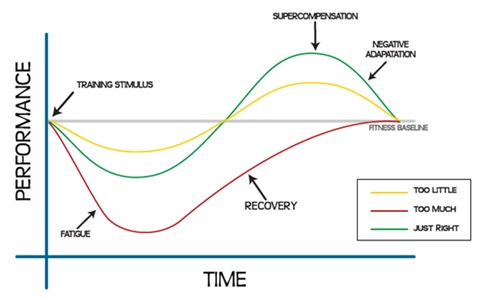
SAID Principle [Specific Adaptations to Imposed Demands] as a diagram – Source: https://www.apki.or.id/specific-adaptations-to-imposed-demands-said/
Now we are not saying that this means the body can miraculously grow back cartilage. Recent evidence has not shown this to be true when it comes to arthritis. What we are saying, however, is that if we don’t do anything to challenge ourselves the rest of our body (muscles, tendons, bone density) will start to become weaker, which will inherently speed up the degenerative nature of our osteoarthritis. Resting and avoiding pain is one of the worst things that can be done for your arthritic condition. In our opinion, a big reason why the condition is called degenerative arthritis is because of the fact that rest and avoidance of pain has so commonly been a recommendation from the medical community at large. Often there is a reason for this, however, in this day and age, more and more evidence is showing the importance of continuing activity in helping improve the condition of arthritis. Plus long term exercise has not been shown to worsen the condition of OA [See our Post with evidence here].
So what are we suggesting?
That you start moving.
Learn how to strengthen your body.
Work with someone who knows how to impart a training stimulus that looks like the green curve instead of the red one.
A big part of work at MTP is learning how to master the art of exercise prescription. There is a reason that all of our practitioners have to study at university for at least 4 years. That reason is because finding exercise that looks like the green line and applying it into someone’s life is difficult. It requires a comprehensive understanding of where that person is at and how they are likely to respond to a certain intervention based on years of clinical research & application.
This is what makes us so passionate about what we do. It’s because we see the difference these changes in mindset make to people’s quality of life and overall happiness.
If you have any further questions or would like us to help you apply this article to you, please don’t hesitate to reach out!
Look forward to seeing you with pain-free knees!
Recent Post
-
Why Do Your Joints Ache in Menopause, and What Helps?
Key Takeaways Falling and fluctuating oestrogen around perimenopause and menopause can leave joints stiff and…
-
Inflammatory Joint Pain: Psoriatic Arthritis and Other Causes
Key Takeaways Inflammatory joint pain is usually stiffest after rest, eases with movement and affects…
-
How Much Does Shoulder Surgery Cost in Australia?
Key Takeaways Public care as a public patient carries no direct cost for the surgery,…
-
Cortisone Injection for Shoulder Pain: Does It Actually Work?
Key Takeaways A cortisone injection settles inflammation and eases pain for a period, but it…
-
Shoulder Pain at Night: Why It Worsens and When to Act
Key Takeaways Lying down loads the shoulder differently and removes the daytime movement that masks…
-
Wrist Pain on the Little Finger Side: TFCC Injuries
Wrist pain on the little-finger side is often a TFCC injury. Learn the signs, why it clicks on rotation, physio-first care and when arthroscopy helps.
-
Wrist Pain After a Fall on an Outstretched Hand
Sore wrist after a fall on an outstretched hand? How to tell a scaphoid fracture, ligament sprain and distal radius fracture apart, and what to do next.
-
Stiff Elbow After a Fracture: Why It Won’t Straighten
Elbow still won’t straighten after a fracture? Why post-fracture stiffness happens, how the rehab window works and when arthroscopic release is considered.
-
A Pop at the Elbow When Lifting: Distal Biceps Rupture
A sudden pop at the elbow when lifting may be a distal biceps rupture. Learn the signs, why the first weeks matter, and repair versus rehab options.
-
Numb Ring and Little Finger: Cubital Tunnel Syndrome
Numb ring and little finger, worse with a bent elbow or at night? Learn the signs of cubital tunnel syndrome and how MTP Health treats it.


