
What we have talked about throughout this article series is a comprehensive list of the factors that are likely to contribute to the causes of Osteoarthritis (OA). What we see with these factors is a comprehensive list of things that are completely preventable.
When we consider all of these factors, we see that education forms the cornerstone of any treatment intervention. Effective education combined with a well-structured exercise program and an effective weight loss strategy should be the ‘go-to’ treatment for anyone who is suffering from the symptoms of OA (i.e. Knee pain, joint stiffness, reduced mobility) or is at risk of developing the condition (as outlined in all other parts of this series).
In our opinion, this is what value-based healthcare is all about. Providing the most effective solutions for the patient that maximise the return on investment for the patient. Whether it be financially (education, exercise and weight loss are by far the most cost-effective interventions for OA over the long term), time-wise (education, exercise and weight control are advantageous as they are empowerment focused interventions that require an upfront investment of time to learn the skills. Once learnt, these skills will stay with the person for life and if properly set up, will require minimal to no maintenance) or based on overall quality of life, these lower-order interventions are by far the most beneficial for a patient. If they can produce the desired result without the need for any higher-order interventions, then this is a fantastic example of value-based healthcare that has the patients best interest at heart.
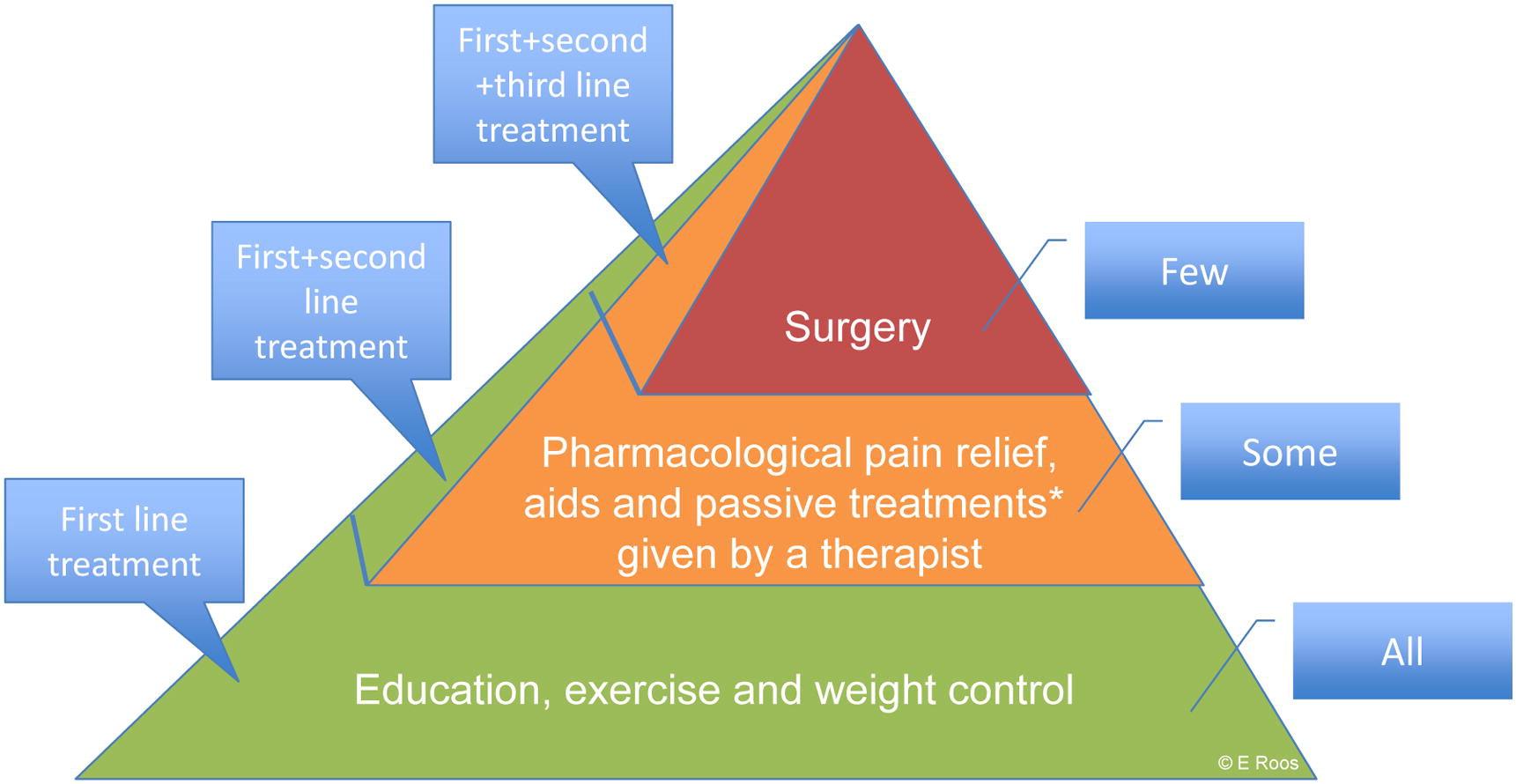
A Pyramid of the Order of Interventions for OA
The issue that we have found throughout our time in private practice is that it can be hard to get all of these lower-order elements (level 1 above) right.
- Education requires not only a focus on the information itself, but also a consideration of where the patient is currently at in terms of their knowledge and beliefs. Often an effective education strategy will require a patient-centred approach aimed at behaviour change through shifting their beliefs. For patients that are suffering quite severely from OA, this can be incredibly challenging, as it required a lot of buy-in from the patient (see part 7).
- Weight Control is a challenge, as it is incredibly behaviourally driven. There are a whole host of factors that will impact on someones ability to maintain a healthy weight, with exercise only being a small part of this equation. Ideally, the patient needs to make a shift in behaviour patterns reflecting new skills that have been learnt in order for them to maintain a healthy weight for life. When done effectively, this can have huge impacts on someone’s condition.
- Specialised Exercise is something that is going to be different for every person who suffers from OA. There is a huge difference in different forms of exercise, yet in the research, it is typically only classified as ‘land-based’ or ‘aquatic’. Within the category of land-based exercise, there are millions of different options about what can be done. For someone with OA, an effective exercise program requires a fundamental understanding of human physiology, as well as experience working with people who have a similar condition. If these parameters are not followed, the patient risks have a negative experience with exercise, which can ultimately make their condition worse.
Because of these 3 things and the difficulty of addressing each of them, we have created our program. Over our years of clinical work, we came to realise that there was a huge need for a program that was more comprehensive than anything else that was being offered. Hundreds of people were coming to us with knee pain that wasn’t getting any better with the other options that were out there. What we soon found out, was that each of these programs only addressed part of the equation, when it came to OA. As such, we have pooled together all of our resources to create the most comprehensive ecosystem of treatment for OA as an industry-leading form of musculoskeletal medicine. This ecosystem comprehensively addresses the 3 factors that are listed above, utilising the information that has been shared within this article series.
Key points: What Causes OA
- Our body adapts to how we use it (Use it or lose it)
- Our beliefs and associated lifestyle is a major contributor
- Having the right mindset can change everything (from pain to day to day experience & eventually function)
- There are a lot of risk factors associated (which can easily be mitigated with effective intervention)
See the infographic below that acts as a very nice picture to summarise a lot of the points that we have covered. While it doesn’t quite cover everything we have discussed, it acts as a very nice summary.

Interventions

Other Useful Resources
- MyJointPain.Org – A comprehensive list on the facts about OA. Very useful for patients wanting basic information on all the treatment options available for their condition, particularly those with a condition that is very severe. Keep in mind the information on exercise is very general and basic.
- OARSI – The Worlds leading research organisation on Osteoarthritis.
- GLA:D program – An exercise-based program delivered by physiotherapists designed for people of lower function. The GLA:D program is a perfect program to start with before undergoing the Knee Program. We can definitely work with patients who are at the low levels of function suited for the GLA:D program, however, will recommend this program at times if it is more convenient for the patient as an introduction.
Recent Post
-
Hip Pain After A Fall In Your 60s
Hip pain after a fall in your 60s may be a fracture, bone bruise or gluteal tendon injury. Dr Donald Cawthorne explains how to tell them apart.
-
Outer Hip Pain When Lying On Your Side
Outer hip pain when lying on your side is usually gluteal tendinopathy, bursitis or a tendon tear. MTP Health explains the causes, sleep fixes and next steps.
-
Why Hip Problems Cause Groin Pain
Groin pain is often the hip joint, not a pulled muscle. Dr Donald Cawthorne explains why hip problems refer pain to the groin and what MTP Health can do.
-
Knee Pain With A Normal Knee Scan
Knee pain but a normal MRI? Dr Jonathan Negus explains how hip arthritis, lower back nerve roots and load present as knee pain, and what to do next.
-
Bone Bruise And Bone Marrow Lesion Knee Pain
Bone bruise or bone marrow lesion on your knee MRI? Dr Jonathan Negus explains why bone hurts, healing times, loading and when subchondroplasty may help.
-
A Swollen Knee: What The Fluid Tells You
How fast a knee swells, and whether it keeps returning, points to the cause. Dr Jonathan Negus explains what the fluid means and when to seek help.
-
Morning Joint Stiffness: Why It Happens and How Long Is Normal
Key Takeaways Brief morning stiffness that eases within about half an hour is common and…
-
Knee Pain After A Twisting Injury
Twisted your knee? Learn how ACL, meniscus and MCL injuries differ, what to do in the first 72 hours and when to book an assessment with MTP Health.
-
Why Joint Pain Feels Worse at Night, and What Actually Helps
Key Takeaways Joint pain at night often worsens because anti-inflammatory cortisol falls overnight while inflammation…
-
Adult Hip Dysplasia: Symptoms, Diagnosis and Treatment Options
Key Takeaways Adult hip dysplasia means the hip socket is too shallow to fully cover…


