Thanks for tuning in to another episode of empowering insights.
The concept of functional to structural decline is what we feel really helps to separate us from other rehab providers. We regularly get comments like “I’ve exercise before, but not like this” when people come to see us. This is the kind of experience that becomes a regular feeling when you are doing exercise that is perfectly catered to where you are at that time. And that’s really what the movement Hierachy is all about.
Show notes:
- What the difference between an acute injury and functional decline is [and why most injuries occur as a result of movement].
- Why gradual ramp-ups in pain are so common.
- Why looking for ONE specific cause may not be super helpful.
- The concept of the Movement Hierarchy (See images below).
- How to use the movement hierarchy to clearly lay out the plan for where your health and movement is headed.
- Where most people get it wrong when it comes to their own movement & fitness (Hint: the answer will challenge you).
- What you can do if you experience random flare-ups such as back pain.
- Why you should start treating your mind and body as the same thing when it comes to rehab & fitness.
- Plenty, more!
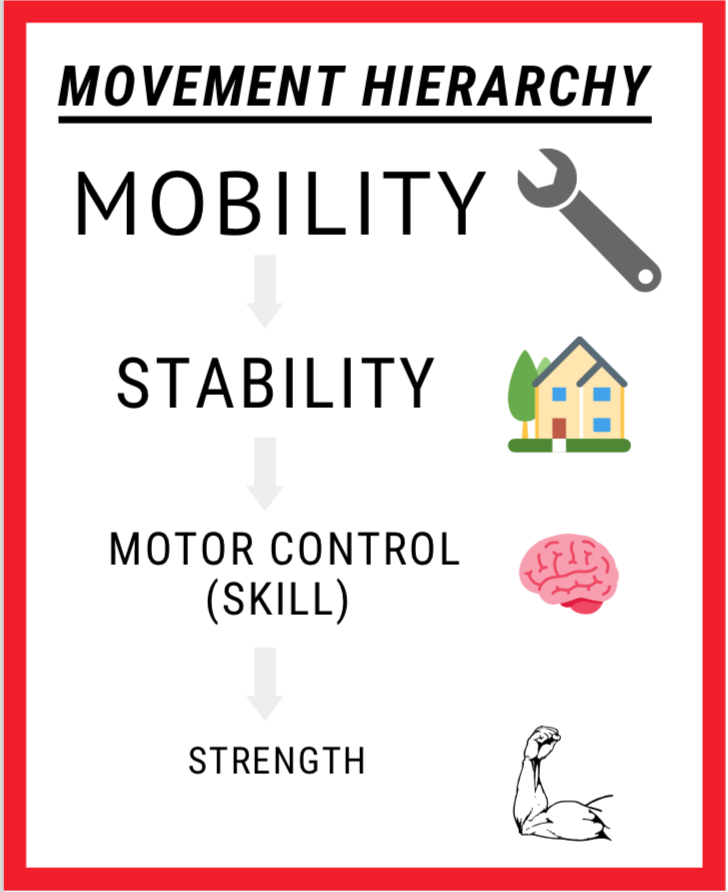
BONUS: See where the movement hierarchy applies to your current training regime
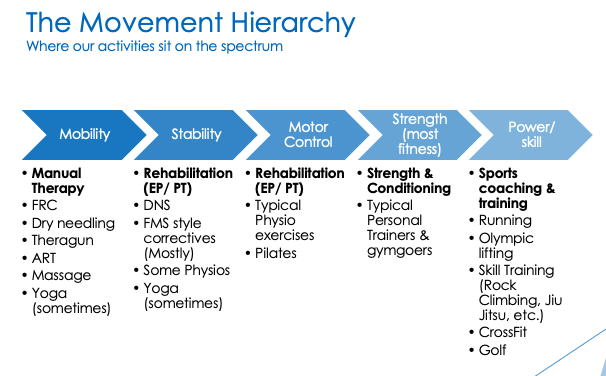
- Most people start way too far on the right-hand side of the Movement Hierarchy spectrum.
- This leads to all sorts of problems if they don’t have the proper pre-requisites from the lower ends of the hierarchy.
- Each stage in the hierarchy is essentially a progression from the one before it (left to right) in increasing order of complexity.
- Not everyone will need to focus on the elements to the left of the movement hierarchy, however, as a general rule of thumb, those who have not been active in a number of years or lack a STRONG base of athletic preparation will need to address some of these elements.
- If addressed early enough in the process these elements can be quite simple & easy to take care of.
- A person does not need to stop doing all other exercise to address components at any end of the spectrum, they simply need to intelligently modify and manage themselves effectively.
To see a detailed, scientific breakdown of the movement hierarchy, along with practical recommendations, check out our comprehensive article HERE
Recent Post
-
Robotic Hip Replacement Cost in Australia: What You’ll Actually Pay
Key Takeaways Robotic hip replacement cost in Australia is built from separate surgeon, anaesthetist, hospital,…
-
Is Robotic Hip Replacement Worth It? What the Evidence Says
Key Takeaways Robotic assistance places the hip socket more accurately than manual technique, though research…
-
Robotic vs Traditional Hip Replacement: The Difference That Matters
Key Takeaways Robotic and conventional hip replacement are performed by the same surgeons, using the…
-
Robotic Knee Replacement in Sydney: How It Works and Who It Suits
Key Takeaways Most tightness in the first six weeks comes from swelling, healing tissue and…
-
Knee Replacement Stiffness: What’s Normal and What Can Be Treated?
Key Takeaways Most tightness in the first six weeks comes from swelling, healing tissue and…
-
Shared Decision Making in Joint Surgery: How to Be an Active Partner in Your Surgery Decision
Key Takeaways Shared decision making pairs your surgeon’s clinical knowledge with what only you know…
-
Slow Recovery After Joint Replacement: How the Treatment Plan Adapts
Key Takeaways Slow recovery after joint replacement is common and often reflects your starting strength,…
-
Trigger Finger and Stiff, Sore Hands: What’s Going On?
Key Takeaways Trigger finger develops when a flexor tendon struggles to glide through a thickened…
-
Bilateral Hip Replacement: Can Both Hips Be Replaced at the Same Time?
Key Takeaways Both hips can be replaced under one anaesthetic, though this suits a narrower…
-
Golf After Hip Replacement: Can I Travel and Play Tennis Again?
Key Takeaways Golf after hip replacement often starts with putting and chipping from around six…