
Key Takeaways
- Hamstring tendinosis is a chronic overload problem of the hamstring tendon, also called proximal hamstring tendinopathy or hamstring tendonitis.
- It can cause pain when sitting, through compression on the tendon, and when climbing stairs or walking uphill, through stretch.
- Diagnosis relies mainly on a physiotherapy assessment, with MRI used when the picture is unclear or a tear is suspected.
- Changes on a scan do not match pain levels closely, so function is usually a more useful guide to how you are tracking.
Lingering or recurring hamstring or glute pain, especially the kind that flares when you sit, is often worth a closer look. Hamstring tendinosis can be a real pain in the butt.
You may also hear it called proximal hamstring tendinopathy or hamstring tendonitis. It sits alongside other hamstring and groin injuries, which is why an accurate diagnosis matters.
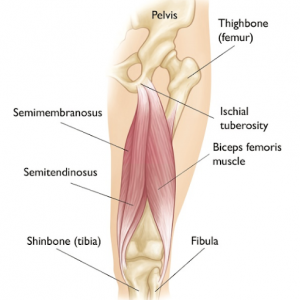
What Is Hamstring Tendinosis?
Hamstring tendinosis is a chronic overload issue of the hamstring, resulting in the deterioration of the tendon. This can result in pain at rest when sitting (through compression on the tendon) and when active and moving, such as walking up stairs or uphill (through increased stretch on the tendon).
It most often affects the tendons that attach the hamstrings to the sit bone, including the conjoint tendon shared by semitendinosus and the long head of biceps femoris, and the semimembranosus tendon. A few details help explain it:
Tendinosis, Tendonitis and Tendinopathy
Tendonitis suggests inflammation, but in persistent tendon pain the tendon is usually changing in structure and struggling with load. Tendinopathy is now the umbrella term clinicians prefer, and tendinosis describes the degenerative end of it. The label matters because tendons generally recover by gradually rebuilding their capacity to handle load, not through rest alone.
Tendinosis Versus an Acute Tear
Acute muscle injuries of the hamstring, such as a strain or tear, most often occur during high-speed running or acute stretch, for example, lunging for a soccer tackle. Like many acute hamstring strains, proximal hamstring tendinosis is managed with a graded loading program based on symptoms, although tendinopathy often improves gradually over a period of months. A complete tear of the tendon from the bone is different and may need a surgical opinion.
In older adults, the tendon is commonly the weakest point in the muscle-tendon-bone unit due to tendon degeneration or chronic tendinosis, which predisposes the tendon to injury.
Typical Symptom Pattern
Due to its chronic nature, hamstring tendinosis can often be a gradual onset of discomfort that is able to be pushed through but gets progressively worse with time.
Patients will often report experiencing localised symptoms at the base of the pelvis, felt as upper hamstring pain, and often report that symptoms settle after warming up, and then return again after they have cooled down. It is also one of several possible causes of hip pain when sitting.
Risk Factors for Developing Hamstring Tendinosis
Several factors may make hamstring tendinosis more likely:
Age
Age is thought to play a part through loss of strength and poorer load tolerance, although these attributes can be trained!
Running Posture
Tight hip flexors may tilt the pelvis forward, and a forward trunk lean when sprinting can increase load on the hamstrings.
Weak Glutes
Weakness in the gluteus medius, a muscle on the side of the hip, may allow the hip to drift inward or the pelvis to drop during squatting and lunging.
Load Spikes
Sharp increases in activity are a common trigger for hamstring tendinosis. Common examples include big increases in running volume, the introduction of hill runs or a sudden increase in lunging exercises.
How Is Hamstring Tendinosis Diagnosed?
Hamstring tendinosis is usually diagnosed through a physiotherapy assessment, with imaging added when the findings are unclear or the injury may be more severe. The main tools are:
Physiotherapy Assessment
Just because something hurts doesn’t always mean you have injured that area. That’s why it helps to have a physiotherapy assessment, where a physiotherapist can conduct a thorough history and examination to determine if your pain is irritation to the hamstring tendon or if your pain is secondary and being referred from other areas such as the lumbar spine, sacroiliac joints or the gluteal muscles.
This diagnostic assessment should typically include (but is not limited to):
- Subjective assessment of your background and experience.
- History, onset and timeline.
- Patient-reported aggravators and relievers of symptoms.
- Your own expected recovery time and the level of activity you want to return to.
- Objective assessment of measurable function and tolerance.
- Stretch tolerance through range, using tests that place both length and compression demands on the tendon.
- Puranen-Orava test.
- Modified bent knee test.
- Strength on the affected side compared with the non-affected side, using both isolation and compound movements.
- Prone hip extension test.
- Prone knee flexion test.
- Lunge test.
- Power and reactive strength, measuring tolerance and capacity under increased dynamic energy and compressive stresses.
- Counter-movement jump test.
- Depth drop test.
If your presentation on assessment is still not clear to your physio, or if your physio feels there will be added benefit in the information provided by imaging, then they may refer you for this.
Imaging
A magnetic resonance imaging (MRI) scan is the primary imaging medium used to identify structural change to the tendon and severity of structural compromise. For instance, if there has been a complete tear, otherwise known as an ‘avulsion’, from the tendon attachment site, this will be identifiable through MRI. This will assist with ruling in or out other medical intervention beyond exercise rehabilitation alone.
However, in the case of tendinosis, the degree of change that is evident on the scan does not correlate well with pain scores, and your level of function is a more accurate correlate of pain experience, which is great because it is what you can address!
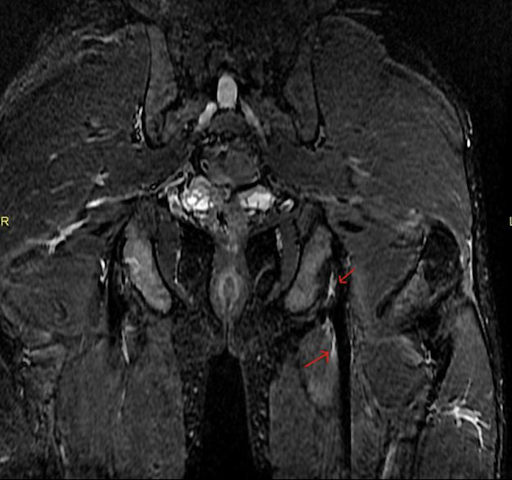
Proximal hamstring avulsion indicated by red arrows.
Clarity on the Ache Beneath Your Sit Bone
Through the appropriate assessment with your physiotherapist, a diagnosis can be made, a treatment plan established and treatment can begin.
For more severe cases, a referral to a sport and exercise physician might be warranted to determine if medical intervention is required prior to commencement of physiotherapy treatment.
Once the diagnosis of the injury is made, the fundamental objective is to establish your starting point of tolerance of load, stretch and compression so you can take the next and most important step, commencing the rehabilitation.
Remember that the pain you are experiencing is usually a symptom of your tendon not having the capacity to tolerate the demands of what you are doing. To address this, we need to improve the strength of the tendon and the muscles around the hip and knee! Our exercise physiologists work alongside physiotherapists to build that strength in stages.
Staged strength work is also central to breaking the cycle of repeated injuries.
If a deep ache at your sit bone is holding you back, the team at MTP Health can assess what is driving it and talk you through the options that suit your circumstances, or your GP can help you decide on the next step.
Frequently Asked Questions (FAQs)
1. How long does hamstring tendinopathy take to heal?
Recovery varies widely. Many people notice steady improvement over three months or more of consistent, progressive loading, and longer-standing cases can take longer.
2. Should I stretch my hamstring if I have tendinopathy?
Deep hamstring stretches, especially with the hip bent forward, compress the tendon against the sit bone and may aggravate symptoms early on. Many rehabilitation programs limit these stretches at first and reintroduce range gradually.
3. How can I ease hamstring tendon pain when sitting?
A softer seat or cushion, sitting evenly on both sides and regular breaks to stand can reduce compression on the tendon.
This article is general information only. It does not take into account your objectives, circumstances or health needs. Speak with your GP or a qualified health professional before acting on it or changing your training or treatment.
If you have ongoing hamstring tendon pain, book an appointment with our knee team. MTP Health has orthopaedic and physiotherapy clinics on Sydney’s North Shore (St Leonards) and Northern Beaches (Frenchs Forest).
Recent Post
-
Pain at the Front of the Shoulder: Biceps Tendon Pain Explained
Pain at the front of the shoulder is often the biceps tendon. Dr Mun Khin Chan explains causes, a physio-first plan and when tenodesis is considered.
-
Shoulder Pain After a Fall: What Could Be Injured
Shoulder pain after a fall? How to tell a rotator cuff tear, proximal humerus fracture and dislocation apart, and what to do next, from MTP Health Sydney.
-
Gout: The Joint Pain People Don’t Expect
Key Takeaways Gout tends to arrive suddenly, often overnight, as severe pain, swelling and redness…
-
Is My Hip Pain Coming From My Hip or My Back?
Key Takeaways Hip-joint pain tends to sit deep in the groin or front of the…
-
Sudden Hip Pain With No Injury
Sudden hip pain with no injury? Dr Donald Cawthorne explains avascular necrosis, femoral neck stress fracture and transient osteoporosis of the hip.
-
Clicking, Cracking, Popping Joints: Harmless or a Warning Sign?
Key Takeaways Most joint noise comes from gas releasing inside the joint fluid or from…
-
Hip Pain at Night and When Lying on Your Side: Why It Happens
Key Takeaways Lying on your side presses your body weight onto the outer hip, loading…
-
Hip Stiffness Putting On Shoes And Socks
Can’t reach your foot for socks and shoes? Learn why hip rotation is lost first in hip osteoarthritis, a home self-check and how MTP Health can help.
-
Hip Replacement Pain That Isn’t Settling
Pain after a hip replacement that isn’t settling? Dr Donald Cawthorne explains what it can mean, how it is assessed and when revision is discussed.
-
Deep Buttock Pain: Tendon, Nerve Or Hip Joint
Deep buttock pain can come from the hamstring tendon, the sciatic nerve or the hip joint. Learn how to tell them apart and how MTP Health treats each one.


