Has anyone ever told you that you have degenerative arthritis?
Leaves quite a visceral image in the mind doesn’t it!
The picture of a chalky bone, crumbling apart like the Cliffs of Dover while the smooth Teflon like cartilage appears jagged and ripped apart. We imagine that with each step we take, the precious cartilaginous ends of our bones are slamming into one another causing more and more damage to appear as if our bones were part of some poorly oiled machine. And this is the narrative that most of us run with when we think of arthritis.
Fortunately, this isn’t quite the case
You see, our body is actually one big ecosystem. An ecosystem that is in a constant state of flux. If we remember back to high school biology, chances are the word homeostasis will be familiar to us. Well, that’s precisely what articulates why the idea of ‘degenerative arthritis’ doesn’t quite tell the whole story. Because our body will always try to achieve homeostasis (return to a baseline), our whole ecosystem (and millions of parts e.g. bones, joints, organs, veins, muscles etc.) will constantly react to the stimulus it faces. When we combine homeostasis with another physiological principle known as Specific Adaptations to Imposed Demands [SAID] we see what actually occurs.
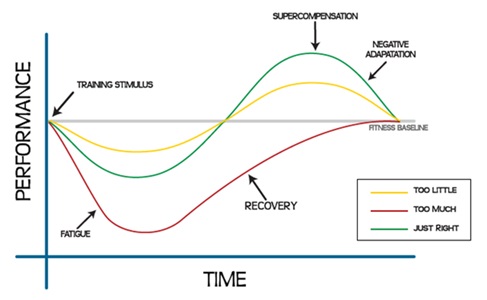
SAID Principle [Specific Adaptations to Imposed Demands] as a diagram – Source: https://www.apki.or.id/specific-adaptations-to-imposed-demands-said/
Now we are not saying that this means the body can miraculously grow back cartilage. Recent evidence has not shown this to be true when it comes to arthritis. What we are saying, however, is that if we don’t do anything to challenge ourselves the rest of our body (muscles, tendons, bone density) will start to become weaker, which will inherently speed up the degenerative nature of our osteoarthritis. Resting and avoiding pain is one of the worst things that can be done for your arthritic condition. In our opinion, a big reason why the condition is called degenerative arthritis is because of the fact that rest and avoidance of pain has so commonly been a recommendation from the medical community at large. Often there is a reason for this, however, in this day and age, more and more evidence is showing the importance of continuing activity in helping improve the condition of arthritis. Plus long term exercise has not been shown to worsen the condition of OA [See our Post with evidence here].
So what are we suggesting?
That you start moving.
Learn how to strengthen your body.
Work with someone who knows how to impart a training stimulus that looks like the green curve instead of the red one.
A big part of work at MTP is learning how to master the art of exercise prescription. There is a reason that all of our practitioners have to study at university for at least 4 years. That reason is because finding exercise that looks like the green line and applying it into someone’s life is difficult. It requires a comprehensive understanding of where that person is at and how they are likely to respond to a certain intervention based on years of clinical research & application.
This is what makes us so passionate about what we do. It’s because we see the difference these changes in mindset make to people’s quality of life and overall happiness.
If you have any further questions or would like us to help you apply this article to you, please don’t hesitate to reach out!
Look forward to seeing you with pain-free knees!
Recent Post
-
Can You Run, Cycle, or Hike After a Partial Knee Replacement?
Key Takeaways Many patients can return to cycling, hiking and other low-impact activities after partial…
-
What Type of Anaesthetic Is Used for Knee Replacement Surgery?
Key Takeaways Anaesthetic planning for knee replacement is individualised, with your surgeon and anaesthetist recommending…
-
How Orthopaedic Surgeons Decide If You’re Ready for a Knee Replacement
Key Takeaways Readiness for knee replacement is based on the combination of your symptoms, daily…
-
Realistic Expectations for Joint Replacement Surgery and What a Good Outcome Looks Like
Key Takeaways Good outcomes are usually measured by meaningful pain relief and a return to…
-
Strength Training With Arthritis: Is It Safe?
Key Takeaways Australian movement guidelines recommend muscle-strengthening activity on two or more days a week…
-
Integrated Orthopaedic and Physiotherapy Care: How Your Surgeon and Physio Work as One Team
Key Takeaways Integrated orthopaedic and physiotherapy care means your surgeon, physiotherapist and general practitioner work…
-
Post-Surgery Physio in Sydney: What Rehab After Joint Surgery Actually Looks Like
Key Takeaways Rehabilitation usually moves through protection, movement, strength and return to activity, with progression…
-
Urgent Injury Clinic in Sydney: What It Does and When to Skip the ED
Key Takeaways Urgent injury clinics in Sydney can assess a new injury within days, settle…
-
Do I Need Carpal Tunnel Release Surgery? Signs, Tests and Timing
Key Takeaways Intermittent tingling that eases when you shake your hand often responds to splinting,…
-
Am I Too Young for a Partial Knee Replacement? Age, Activity, and Eligibility Explained
Key Takeaways Age alone does not determine whether you are suitable for partial knee replacement;…