

A lot of astute gym goers, crossfitters and trainers recognise this and aggressively try and increase their hip extension by stretching their hip flexors (illiopsoas). While the hip flexors are a great place to start another significant and often poorly stretched muscle is rectus femoris (RF). The RF is crosses both the knee and the hip joints, for this reason it is very often overworked and is quite susceptible tightness. Because the RF crosses two joints it is also a prime candidate to have an negative impact on the lower back position. By pulling on the AIIS (front of pelvis) it can tilt the pelvis forward slightly causing the low back to arch to accomodate the change of position.

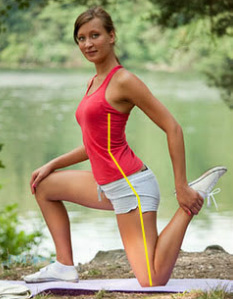
Make sure you keep the lower leg at or above 90degrees of hip flexion. Take hold of the ankle of the upper leg and pin it to your backside. Keep the ankle pinned to your backside while you drive your knee back as far as you can, opening the hip into full extension.


Recent Post
-
Know your supplement: Creatine
In the first of a series of blog posts, MTP’s resident Sports Dietitian Juliana Lisboa…
-
The Heat is ON.. Tips to achieve a Positive Energy Balance
By Rebecca Chin, Accredited Practising Dietitian and Nutritionist With summer just around the corner,…
-
A Dietitians Fuel
By Rebecca Chin, Accredited Practising Dietitian and Nutritionist As I Dietitian, I naturally get…
-
Got shoulder pain going overhead? Watch this.
Part 1 of a series of video blogs on managing and preventing shoulder impingement. The…
-
The static stretching debate: what does it mean for CrossFit participants.
by Luke Kane Exercise Physiologist – Movement Specialist “Is it safe to stretch before…
-
-
Osteoarthritis and Exercise: Should you train through the pain? What can you do about it?
By Nick Burrows – Exercise Physiologist Osteoarthritis (OA) is a degenerative joint disease characterised primarily…
-
Super Crab: A quick shoulder and glut activation drill to use before 14.4
The combination of movements involved in 14.4 will mean a release of some epic…
-
Glute activation – ‘The Crab Walk’ ideal position and common faults
Band resisted side stepping or crab walking as it’s more commonly known, is an…
-
The importance of glute max activation in lower limb rehabilitation.
In 1994 Bullock-Saxton wrote a groundbreaking article about glute max inhibition after ankle sprains.…
