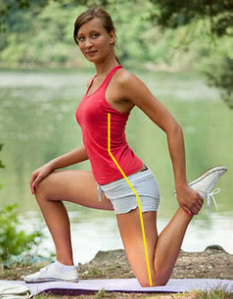
One piece of the movement puzzle I see missing all the time is good hip extension. A lot of emphasis is placed on strengthening the posterior chain these days and for good reason. However the value of a strong posterior chain or powerful hip drive is lost if you dont have the range of motion to deliver this strength through a full range. Your gluteus maximus is the main contributor to powerful hip extension and its strongest contraction strength is seen in full (terminal) hip extension. So it goes without saying that if you are unable to full extend your hip then you are going to miss out on some signifiicant glute assistance which means less power.

No hip extension issues here!
The most common compensation for lack of hip extension is to extend (arch) the lumbar spine. You will get away with this for quite a while but eventually this extra demand on the low back to make up for the hip will result in some low back pain.
A lot of astute gym goers, crossfitters and trainers recognise this and aggressively try and increase their hip extension by stretching their hip flexors (illiopsoas). While the hip flexors are a great place to start another significant and often poorly stretched muscle is rectus femoris (RF). The RF is crosses both the knee and the hip joints, for this reason it is very often overworked and is quite susceptible tightness. Because the RF crosses two joints it is also a prime candidate to have an negative impact on the lower back position. By pulling on the AIIS (front of pelvis) it can tilt the pelvis forward slightly causing the low back to arch to accomodate the change of position.
The trouble with common RF/Quadricep stretches is they dont limit lumbar spine movement, so what ends up happening is we continue to compensate for our tight RF with excessive low back extension.
The easiest way to limit your lumbar movement in a quad/RF stretch is to flex the opposite knee to 90degrees. This will act to block the lumbar spine from moving into extension. So here’s how you check if you are missing some hip extension.
Make sure you keep the lower leg at or above 90degrees of hip flexion. Take hold of the ankle of the upper leg and pin it to your backside. Keep the ankle pinned to your backside while you drive your knee back as far as you can, opening the hip into full extension.

Start position

Finish position
Take note of your finish position, have a friend hold a broomestick above you aligned through your shoulder and and hip. If your knee is still in front of the stick you need to spend some time here. When you are in full extension squeeze your glute and try to drive you hip forward. Hold each glute squeeze for 10seconds, relax and repeat. Accumulate 2 mins of stretch time on each side.